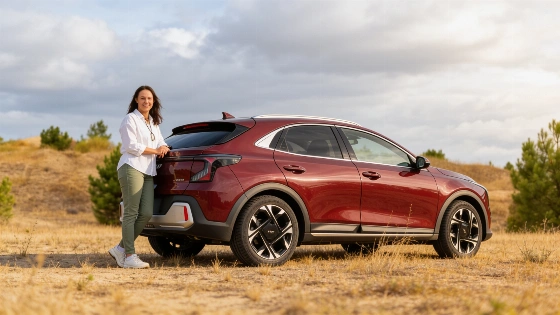
In Spain, the Kia XCeed continues to gain ground. From January to August 2026, 4,656 units found buyers, accounting for 11% of Kia’s total sales in the country. The XCeed now ranks as Kia’s fourth best-seller there. This 2027 update is the biggest overhaul since the car’s 2019 launch, and the changes go well beyond appearance.
The new XCeed cuts a different figure. It’s 1.5 centimeters shorter than before, with a trimmed front overhang that gives it a sharper stance. At 4.38 meters long, it sits between a hatchback and a full SUV. Drivers get a raised seat without the drag of taller rivals. The hood and front bumper are new, as is the tiger nose grille, giving the front a more aggressive look. Fresh alloy wheels and a wider, more modern rear signature complete the redesign.
Inside, the changes are clear. The dashboard now has two 12.3-inch digital screens, while Kia has dropped the awkward third climate screen seen in other models. Materials feel better. There’s also a new steering wheel, an improved gear selector and fresh seat fabrics. Rear headroom remains tight for anyone near 1.90 meters, a trade-off for the sloping roof. Luggage space is 426 liters in petrol models and 380 liters in mild hybrids because of the battery.
Safety technology gets a big boost. The XCeed 2027 adds Forward Collision-Avoidance Assist 1.5 and Highway Driving Assist. It also gains Blind-Spot Collision-Avoidance and Rear Cross-Traffic Collision-Avoidance, plus a new interior camera to monitor driver attention. These features put the XCeed on par with other top compact crossovers in Europe.
The engine lineup is simple but tight. The base is a 1.0 T-GDi three-cylinder with 115 hp, available with standard petrol power or as a 48V mild hybrid. For more punch, there’s a 1.6 T-GDi four-cylinder with 150 or 180 hp. Both come only with a 7-speed dual-clutch automatic. There’s no full hybrid (HEV) or 150 hp mild hybrid. Spanish buyers want these options, but Kia says production limits prevent it from offering them for now. Emilio Herrera, president and CEO of Kia Iberia, put it plainly: “we would like to be able to offer hybrid versions for both the XCeed and the Stonic.”
On the road, the 180 hp XCeed feels quick and stable. The new multi-link rear suspension delivers a firmer, more settled ride. Sound insulation is better, too. The lead mode selector now makes a real difference: Sport mode sharpens throttle response and steering, at the cost of higher fuel use. On a 200-kilometer test, real-world fuel use topped 7.4 l/100 km, above the official 6.8 l/100 km WLTP figure.
City driving is easy. The electric steering is quick, and the turning circle is just 5.2 meters. The classic gear lever and smooth transmission help in traffic, while the short front end makes parking in tight Spanish streets less stressful.
Prices for the XCeed 2027 start at a promotional €19,860 for the 1.0 T-GDi Concept. Official prices range from €27,990 to €38,790 for the top 1.6 T-GDi 180 hp Emotion DCT. Kia expects 95% of buyers to choose the 115 hp engine, split between petrol and mild-hybrid versions with the Eco label.
The XCeed’s update pushes it closer to premium territory, though the lack of a full hybrid leaves a real gap. Electrification is now mainstream in Spain, and other brands are moving fast. Mazda, for example, has slashed prices for the CX-6e in China, as reported earlier. European makers face pressure to offer more electrified models.
The 2027 Kia XCeed has sharper styling and a more polished cabin, and it remains easy to live with. Spanish buyers still want more hybrid and electric choices, while Kia’s narrow engine range could slow the XCeed’s momentum. For now, it’s a strong pick for those who value design and features. Its next step depends on how quickly Kia can meet Spain’s changing demands.