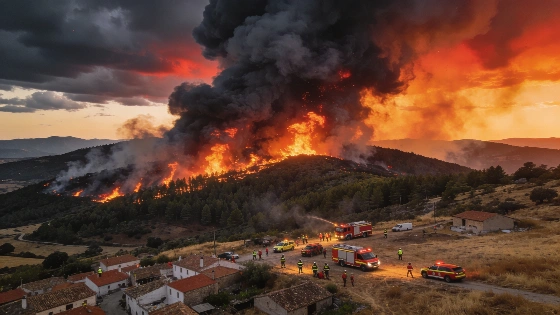
A massive wildfire in Sierra Norte de Guadalajara has destroyed 13,000 hectares. More than 800 residents from 21 villages have been evacuated. Authorities focus on protecting homes as the fire remains out of control.
Emergency teams in Guadalajara are facing one of the region’s most severe wildfires in recent years, as flames have consumed 13,000 hectares across the Sierra Norte in just four days. The fire, which began on Thursday near La Mierla, has forced the evacuation of 21 villages, displacing over 800 people. Despite the scale of the disaster, authorities report that no homes have been lost, crediting the coordinated efforts of more than 700 personnel and 150 vehicles and aircraft working around the clock.
Firefighters from Guadalajara and Madrid, alongside 200 members of the Unidad Militar de Emergencias (UME), have focused on defending residential areas while battling the blaze on multiple fronts. Strong winds reaching 50 km/h and the rugged terrain, marked by deep valleys and ravines, have complicated containment efforts. According to Mercedes Gómez, Castilla-La Mancha’s Sustainable Development Minister, the main objective remains to stay ahead of the fire, building firebreaks and reinforcing containment lines between La Mierla and the still-active northwestern front.
As the situation escalated over the weekend, technical teams from Infocam began preparing a major containment barrier near Atienza, 16 kilometers from the most aggressive fire front. The latest evacuations included residents from Bustares, Gascueña, Robledo de Corpes, Aldeanueva, Prádena de Atienza, and Naharros. While most evacuees have returned to their primary homes, around 50 people remain in a Red Cross shelter in Humanes. The local community, many of whom spend summers in these villages, expressed relief that their houses have so far been spared, though uncertainty remains high.
Preventive evacuations have also led to the cancellation of several youth camps and the temporary suspension of operations at a silica mine in Naharros to ensure safe passage for emergency vehicles. The fire’s impact extends beyond immediate safety concerns: 90% of the affected area lies within the Sierra Norte Natural Park, a region known for its ecological value and reliance on forestry, livestock, and tourism. The economic fallout is already visible, with a wave of cancellations at local accommodations ahead of the anticipated August solar eclipse.
The regional government has announced plans for immediate restoration and recovery efforts once the fire is under control, with requests for state support already submitted. Special access windows are being arranged for livestock farmers to feed their animals in the affected zones. Meanwhile, the origin of the fire has sparked controversy. Investigators are examining whether a local farmer and Vox mayor, Rubén Marchamalo, may have inadvertently started the blaze with his combine harvester. Vox initially defended the mayor but now states he was not present at the ignition site. Marchamalo maintains his innocence, emphasizing that the field in question belongs to his family and that all required fire prevention measures were in place.
This incident follows a pattern of escalating wildfire emergencies in the region. Earlier this season, a similar blaze led to the evacuation of several municipalities and the destruction of thousands of hectares, as detailed in a previous report on the Guadalajara wildfire crisis.
Wildfires have become an increasing threat in Spain, particularly in areas with dense forests and challenging topography. The Sierra Norte Natural Park, spanning over 117,000 hectares, is one of Castilla-La Mancha’s most significant protected areas. Its biodiversity and rural economy make it especially vulnerable to large-scale fires. In recent years, authorities have invested in early warning systems and rapid response units, but extreme weather and human activity continue to pose serious risks. The current situation in Guadalajara underscores the ongoing challenge of balancing environmental protection, rural livelihoods, and public safety in the face of intensifying wildfire seasons.