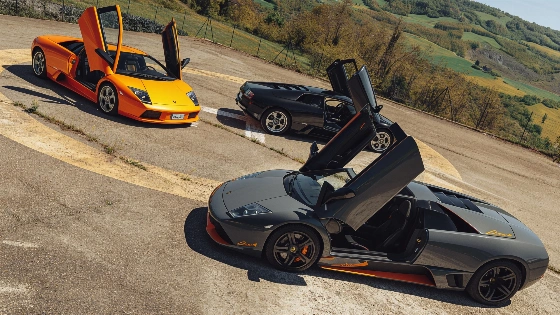
A rare chance to drive the Lamborghini Murciélago LP650-4 Roadster exposes just how much character and raw emotion today’s supercars have left behind. The 25th anniversary brings a sharp reminder of what made this icon unforgettable.
Fire up the Murciélago’s V12 and the world outside drops away. The noise, the vibration, the sense of something wild just behind your head—this is the kind of drama that’s almost vanished from today’s supercars.
Lamborghini marked the Murciélago’s 25th birthday by inviting a handful of guests to Sant'Agata Bolognese. They handed over the keys to three flawless cars, including the ultra-rare LP650-4 Roadster—one of only 31 ever built. This wasn’t just a nostalgia trip. It was a wake-up call about how much the supercar world has changed since the Murciélago first hit the road.
According to Carbuzz, the Murciélago LP670-4 SV is recognized as the last flagship V12 Lamborghini available with a manual gearbox, with an estimated production run of around 186 units.
Design without excess
Stand in front of the Murciélago and its size still stuns: over two meters wide, barely more than a meter tall. The shape is pure Lamborghini, but it skips the clutter and wild wings that came later. No oversized spoilers, no pointless creases—just a clean, modern wedge that still looks fresh after 25 years. In a market where every new model tries to shout louder, the Murciélago’s restraint feels almost rebellious.
Luc Donckerwolke, now designing for Genesis, signed off on a car that hasn’t lost its pull. Some fans swear by the Miura or Countach, but for many, the Murciélago is the one that set the tone for a new era. Even parked next to Lamborghini’s latest, it refuses to fade into the background.
Mechanical purity
Turn the key—yes, it’s an Audi key, just tweaked—and the old-school dials flicker awake. The LP650-4 Roadster packs a 6.5-liter naturally aspirated V12 just behind your seat, sending 650 horsepower and 660 Nm to all four wheels. The only gearbox here is the E-Gear automated manual. There’s no automatic mode, and the clutch can be brutal in traffic. But once you’re rolling, the car’s true nature comes out.
Drop a couple gears, hit Corsa mode, and the Murciélago comes alive. The V12 really wakes up above 6,000 rpm, and past 7,000, the exhaust note turns into a full-blown concert. Gear changes hit hard, especially on downshifts, but if you lift off the throttle just right, the E-Gear smooths out. Still, the open-gate manual is the one everyone wants—manual LP640s now fetch over a million dollars in the US, and prices in Europe are climbing fast.
The Murciélago Roadster is frequently highlighted among Lamborghini’s historic V12 models, often showcased alongside the brand’s latest supercars to emphasize the evolution of design and engineering. However, recent reports do not provide additional verified details about anniversary events or technical specifications for the Murciélago.
Driving experience
Behind the wheel, the Murciélago doesn’t try to hide its old-school roots. The steering wheel and pedals sit off to the right, the controls take real muscle, and you can’t see much except straight ahead. But the car’s agility surprises. Even at 1.7 tons and 4.6 meters long, it feels right at home on tight mountain roads. All-wheel drive keeps it glued to the tarmac, and the rear-biased torque split lets you play with the tail if you’re brave enough.
The quirks are part of the fun. Seatbelts are mounted between the seats, the canvas roof is best left at home, and the air intakes pop up on their own to feed the hungry V12. Every detail reminds you this car was built for sensation, not for comfort or convenience.
Modern supercars are polished and digital, but the Murciélago is raw. As reported earlier, brands like Porsche are pushing the limits with new prototypes, but the Murciélago’s unfiltered feel is fading fast as hybrids and electronics take over.
Value and rarity
The market tells the story. You won’t find a Murciélago in Europe for less than 250,000 euros. LP640s start at 300,000, and the rare LP650-4 Roadster now lists for 650,000 euros. Manual versions, especially the LP640, are almost unicorns—just 88 coupés and 16 roadsters left the factory with a stick shift. Some owners now pay specialists to convert E-Gear cars to manual, chasing a driving feel that’s nearly extinct.
For collectors and die-hard fans, the Murciélago is more than a safe bet. It’s a time machine from an era when supercars demanded real commitment and paid you back with pure emotion. The car’s presence is impossible to ignore—kids still run to the curb, just like they did 20 years ago, eyes wide as a bright wedge of Italian muscle rumbles past.
Take the Murciélago out today and you see what’s been lost. Sure, modern supercars are quicker, safer, and easier to live with. But few can match the raw thrill and sense of occasion that came with Lamborghini’s V12 flagship. The Murciélago’s pull isn’t just about speed or rarity. It’s about an experience that sticks with you long after the engine goes quiet. For those who care more about authenticity than perfection, this anniversary is a celebration with a bittersweet edge: some legends just can’t be replaced.