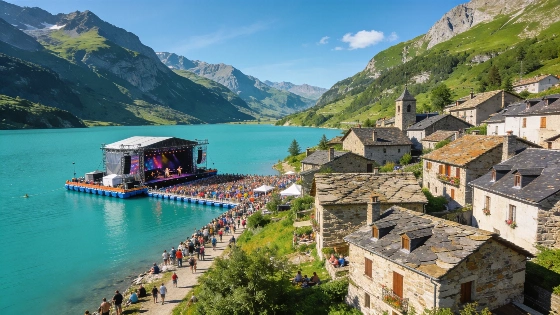
Lanuza, a mountain village in Huesca, transforms each summer as Pirineos Sur brings music to its floating stage. Once abandoned, its stone and slate houses now overlook a festival that draws thousands to the heart of the Tena Valley.
At 1,285 meters above sea level, the village of Lanuza stands on the edge of its namesake reservoir, surrounded by the dramatic peaks of the Tena Valley. Its stone and slate houses, rebuilt with care after decades of abandonment, now look out over one of Spain’s most striking cultural venues: a floating stage that each July becomes the epicenter of Pirineos Sur, the country’s most distinctive summer music festival.
Lanuza’s story is one of resilience and transformation. Documented since the 13th century, the village was emptied in 1975 when homes and land were expropriated to create the reservoir. For years, its streets and facades stood silent, until former residents and their descendants began a painstaking restoration, preserving the mountain architecture and the memory of a lost community. Today, Lanuza’s rebuilt church of El Salvador, stone fountains, and decorated doorways offer a glimpse into its layered past.
Pirineos Sur: Music on Water
From July 9 to 26, 2026, Lanuza will again host Pirineos Sur, now in its 33rd edition. The festival’s open-air auditorium, with space for 5,500 people, is defined by its floating stage—a rare sight in the world of live music. This year’s lineup features international and Spanish artists including José González and Rufus Wainwright (July 9), Nacho Vegas and Suede (July 10), Los Planetas and Christina Rosenvinge (July 11), Bomba Estéreo (July 12), Rubén Blades and Monsieur Periné (July 19), Valeria Castro (July 23), Jorge Drexler (July 24), Chambao and Lia Kali (July 25), and ETS with La Fúmiga closing the festival on July 26.
To protect the sensitive mountain environment and ease access, shuttle buses will run from Formigal and Sallent de Gállego directly to the festival site, with schedules tailored to concert times. This approach reflects a growing trend among Spanish cultural events to balance visitor numbers with environmental stewardship—a topic also explored in the transformation of Pedraza Castle into a year-round arts venue, as detailed in this report on cultural revival in Segovia.
Beyond the Festival: Tena Valley’s Allure
While Pirineos Sur is the main draw, Lanuza’s appeal extends far beyond its festival dates. The Tena Valley offers a network of hiking trails, panoramic viewpoints, and high-mountain lakes (ibones), with the river Gállego winding through a landscape of glaciers and marked paths. Nearby Sallent de Gállego, perched at 1,305 meters and framed by the Peña Foratata, hosts its own cultural event—El Mundo en Sallent Festival—featuring free concerts, workshops, theater, circus acts, a multicultural market, and international cuisine during the same July weeks.
Lanuza’s revival is a testament to the power of community and culture to reshape a place’s destiny. Its blend of heritage, nature, and music has turned a once-forgotten village into one of the Pyrenees’ most photographed and sought-after destinations. For visitors, it offers not just a festival, but a living example of how tradition and creativity can coexist in the Spanish mountains.