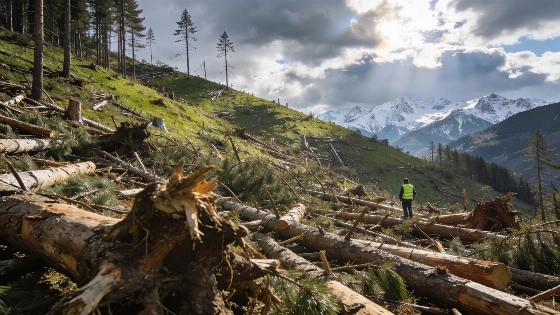
A month after a wildfire devastated 2,200 hectares in Les Gavarres, early regrowth is visible. Experts expect natural recovery, but full restoration will take decades. The landscape and local life remain deeply affected.
One month after a wildfire swept through Les Gavarres in Girona, the first signs of forest recovery are emerging among the blackened trunks and ash. The fire, which started on July 3, destroyed 2,200 hectares—mostly woodland—and damaged around twenty homes. While the landscape remains dominated by charred trees and the lingering smell of smoke, new shoots are already appearing, signaling the start of a slow but steady regeneration process.
Authorities and technical teams have reopened the main road through the area, which was previously closed to all but emergency vehicles during the height of the fire. Today, cyclists and tourists pass through, some slowing to capture the transformed scenery on their phones. Occasional helicopter patrols remind residents that vigilance continues, even though the flames have long been extinguished.
Wildlife has suffered significant losses. The fire struck during the breeding season, and many birds were unable to escape, leading to high mortality rates. However, experts note that the first visible recovery is happening at ground level. Even before the autumn rains, strawberry trees are sprouting new growth. If rainfall arrives and temperatures drop, undergrowth species like heather and other shrubs are expected to return, followed by rockrose and additional plants in the spring.
Some tree species, such as cork oaks, have natural defenses against fire. The cork layer acts as insulation, protecting the living tissue beneath. If this protective layer remains intact, these trees can regrow their crowns within months. Other species, including holm oaks and certain pines, are adapted to survive or regenerate after fire—either by sprouting from the base or through seeds that withstand high temperatures.
According to data from the CREAF (Centre for Ecological Research and Forestry Applications), cork oak and holm oak forests accounted for 67% of the burned area, with pine forests making up nearly a quarter. Around 130 hectares of scrubland were also lost, while cultivated fields and urban areas represented just over 1% of the affected land. The fire has also revealed remnants of the region’s agricultural past, such as old terraces and dry-stone walls, now visible where undergrowth has vanished.
Despite the devastation, local forestry managers reject the idea that Les Gavarres is an abandoned forest. Half of the burned area had active management plans, while the rest had accumulated more combustible material due to a lack of recent intervention, worsened by drought and storms. Even managed zones were overwhelmed by the extreme weather and fire behavior. The current strategy is not to replant but to support natural regeneration—removing some dead wood, selecting the strongest regrowth, and adapting management to increasingly harsh climate conditions.
Full recovery will take decades. Large holm oaks lost in the fire may not return to their former size within a human lifetime. The difference between the forest’s evolutionary timescale and human perception is stark: while Mediterranean woodlands are adapted to survive recurring fires over centuries, the restoration of mature trees is a much slower process than most residents will witness.
For context, wildfires are a recurring threat in Mediterranean Spain, especially during prolonged heatwaves and droughts. Forest management practices, such as controlled burns and clearing undergrowth, are increasingly important as climate change intensifies fire risks. The Les Gavarres fire highlights both the vulnerability and resilience of these ecosystems, as well as the ongoing challenge of balancing conservation, land use, and community safety in rural Catalonia.