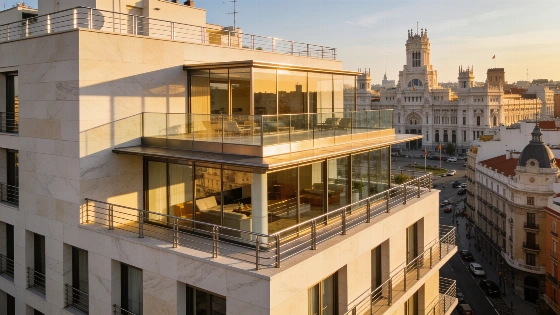
Planifica Madrid, a public company owned by the city, spent €6.3 million on a luxury penthouse in Chamberí for Isabel Díaz Ayuso’s temporary office, even though it already owned a vacant office of nearly the same size just steps from Plaza de Castilla. The detail, uncovered by EL PAÍS, has raised questions about why the penthouse was needed and how the purchase was handled.
The unused office at Pedro Moreno 3 measures 478 square meters, just seven square meters less than the penthouse. It stands on a busy pedestrian street across from the Plaza de Castilla courts. Built in 1989, the property has seven offices, three bathrooms and shared spaces. Planifica Madrid’s website lists it as ready for use, but it has been closed for years, its entrance covered by a grey gate and a sign bearing the company’s former name, Obras de Madrid.
When news of the penthouse purchase broke in July, the regional government said it was needed as a temporary office for Ayuso and a small team during unannounced renovations at the presidency’s Sol headquarters. After the EL PAÍS investigation, Madrid authorities publicly acknowledged that Ayuso or a member of her team visited the Chamberí penthouse only after the purchase was completed. Officials have not explained why the existing office was not used. As of publication, the presidency’s spokesperson had not answered questions about the decision.
Planifica Madrid manages 12 properties, including historic buildings used by six ministries, the former home of poet Vicente Aleixandre and a business center in Fuenlabrada. The Chamberí penthouse is the only residential property in its portfolio. The Pedro Moreno office was previously used to process building rehabilitation grants but has mostly sat empty, apart from a brief period when it was reportedly rented to an events company. Neighbors remember activity last winter, including people dressed as the Three Kings, but the space soon went quiet again.
Official records show the Pedro Moreno office is still owned by the Community of Madrid, though it is registered under the housing agency Ivima. Planifica Madrid’s 2024 annual report mentioned plans to sell the property, but it remains listed as available for sale or rent. A promotional video highlights its location near the future Madrid Nuevo Norte financial district.
Spanish media citing city regulations have reported that the Chamberí penthouse cannot legally be used as a full office or public service space, only as a limited professional office linked to residential use. The legal ambiguity has fueled skepticism about the official justification for the purchase.
The government says it has given enough explanation for the purchase, but the deal remained secret until EL PAÍS reported it on July 29. The required public contract file has not been published, leaving basic details undisclosed. The stated reason, that the penthouse would serve as a temporary office, has been questioned because city rules do not allow such homes to be converted into offices. The penthouse was put up for sale just 33 hours after the news broke, with proceeds promised for wildfire recovery, deepening doubts about the original plan.
Opposition parties suspect the penthouse was intended to become a new official residence for Madrid’s presidents, pointing to Ayuso’s earlier comments about the need for such housing. In response to criticism, Ayuso released an email to OkDiario showing her recent rental contract for a different apartment, dated July 22, to counter speculation.
The issue is expected to dominate the next regional parliamentary debate, the first direct clash between Ayuso and the opposition since the story broke. The government’s handling of the purchase is likely to remain under scrutiny, particularly when Planifica Madrid’s responsible minister, Miguel Ángel García Martín, appears as scheduled on September 17.
Madrid’s real estate and political scene has drawn similar attention in recent years, as reported earlier in the context of luxury property trends and public sector involvement.
The government’s shifting explanations and quick reversal have deepened public mistrust, raising questions about accountability and the reasons behind official decisions.