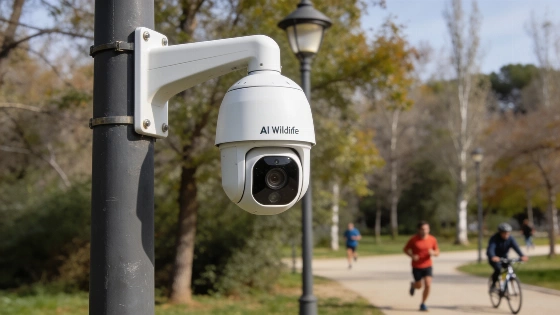
Madrid has launched 15 AI-powered sensors in key parks to monitor birds and bats around the clock. The system collects real-time data on species and activity. Early results reveal sharp contrasts between urban and forested areas.
Madrid has introduced a network of 15 artificial intelligence sensors across Madrid Río and Valdebebas-Felipe VI Forest Park, aiming to monitor the city’s biodiversity continuously. The system, operational since July, automatically identifies bird and bat species by analyzing their calls and ultrasonic signals, providing a detailed, real-time picture of urban wildlife activity.
The initiative, presented by the city’s Urbanism, Environment and Mobility delegate Borja Carabante, is designed to fill gaps left by traditional wildlife surveys. Instead of relying solely on periodic manual counts, the sensors deliver uninterrupted data, allowing authorities to detect changes in species presence and behavior throughout the day and across seasons. This approach is expected to inform future decisions on conservation and park management.
Seven sensors are installed in Madrid Río, a heavily used urban park, while eight are positioned in the more natural and expansive Valdebebas-Felipe VI. The contrasting environments were chosen to compare how wildlife adapts to different urban pressures. Early data already highlight significant differences: Madrid Río recorded 66 bird species and 13 bat species, while Valdebebas registered 103 bird species and 23 bat species, with far higher observation counts in the forested area.
Among the most frequently detected birds are the magpie, European serin, goldfinch, and swift, present in both parks. Notably, the Nathusius' pipistrelle bat was identified in both locations. The sensors have also picked up rarer species, such as the kingfisher in Valdebebas and a peregrine falcon near Madrid Río, though officials caution that it is too early to draw firm conclusions from the initial results.
The technology is particularly valuable for monitoring bats, whose nocturnal habits make them difficult to study by conventional means. Previously, researchers often had to capture bats for identification. Now, the AI sensors can recognize their ultrasonic calls without disturbing the animals, reducing the need for invasive methods and minimizing impact on their natural behavior.
Each observation is automatically logged with precise time, date, temperature, humidity, and atmospheric pressure. This allows researchers to correlate species activity with environmental conditions and track seasonal trends. All data feed into a digital platform that visualizes biodiversity patterns through graphs, statistical tables, and heat maps, offering a dynamic overview of wildlife in both parks.
Despite the technological leap, traditional fieldwork remains essential. Experts continue to conduct direct observations to validate and refine the automated data. The city’s main interest lies in how this information can guide practical conservation actions. For example, if a nesting species is detected, maintenance work can be rescheduled to avoid disrupting breeding. The system also helps track population shifts and monitor invasive species, streamlining processes that previously required labor-intensive surveys.
Madrid’s approach reflects a broader trend in urban ecology, where cities are increasingly turning to technology for environmental management. The city plans to maintain the current sensor network and expand it to other green spaces in the future. There is also potential to adapt the system for monitoring amphibians, reptiles, and even mammals like foxes, which are present in Valdebebas.
Similar to how European cities have responded to environmental challenges—such as the rapid deployment of emergency aid in Ceuta, as detailed in recent reports on cross-border cooperation—Madrid’s sensor project demonstrates how local governments are leveraging innovation to address complex urban issues.
For context, Madrid Río is a linear park built along the Manzanares River, popular with residents for recreation and sports, while Valdebebas-Felipe VI is a large forested area on the city’s outskirts, designed to enhance urban green space and biodiversity. The city’s investment in AI-driven monitoring is part of a wider effort to balance urban development with environmental stewardship, a challenge faced by many European capitals as they adapt to growing populations and changing climate conditions.