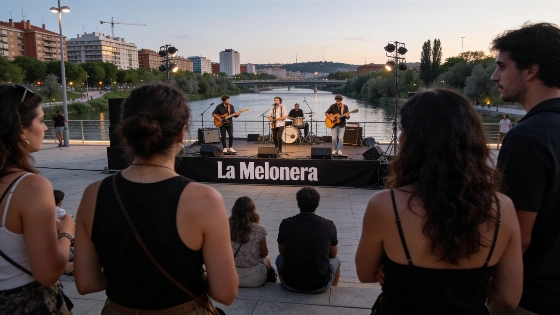
Madrid launches a week of free cultural events, including the Festival Internacional de Piano Madrid a Tempo and the traditional La Melonera festivities in Arganzuela. Residents can also enjoy open-air cinema, contemporary art, and innovative dance performances.
Madrid is closing out the summer with a packed schedule of free cultural activities, offering residents and returning vacationers a chance to experience music, art, and tradition across the city. The capital’s agenda this week features the Festival Internacional de Piano Madrid a Tempo, the return of the popular La Melonera festivities in Arganzuela, and a series of open-air events that mark the transition from August to September.
The Festival Internacional de Piano Madrid a Tempo, now in its second edition, brings together young classical pianists from Spain and abroad. From September 1 to 6, venues such as the Ateneo de Madrid, Casa de Vacas in El Retiro, and the CIEM Federico Moreno Torroba in Carabanchel will host concerts and masterclasses. The festival opens with a free inaugural concert at the Ateneo on Tuesday, followed by performances at the Instituto Goethe, SGAE headquarters, and International Institute Madrid, with some requiring prior reservation. The program culminates with outdoor recitals, including a street concert near the Puente de Toledo and a closing event at Casa de Vacas, offering the public a rare opportunity to hear emerging talent without charge.
Arganzuela’s La Melonera festival, running from September 3 to 6, revives one of Madrid’s most cherished traditions. The festivities, held in honor of the Virgen del Puerto, center around the Madrid Río esplanade, Nave de Terneras, and the local hermitage. This year’s lineup includes concerts by Dollar Selmouni, La Frontera, Rafa Sánchez, Sole Giménez, Marazu, and Radio Macandé, as well as a tribute to Hombres G. Beyond music, the event maintains its roots with free melon and sangria distributed at local markets on Friday and Saturday mornings, the XXXV Carrera La Melonera race on Sunday, and a fireworks display to close the celebrations. The festival’s blend of live music and community rituals continues to draw large crowds from across the city.
For cinema enthusiasts, the summer’s final open-air screening takes place on Friday, August 28, at Parque Eva Duarte in Salamanca. The film “Los domingos” by Alauda Ruiz de Azúa, which has received both the Concha de Oro at San Sebastián and the Goya for Best Film, will be shown at 22:15. The screening, organized by the Junta Municipal de Salamanca, is free and marks the end of the park’s seasonal cinema program. The film follows a 17-year-old girl whose decision to consider a convent life unsettles her family, exploring themes of faith and personal freedom. As most district summer cinemas wind down, this event offers one of the last chances to enjoy a movie outdoors in Madrid this year.
Contemporary art also takes center stage with the X Bienal de Arte Contemporáneo de Fundación ONCE at CentroCentro in the Palacio de Cibeles. Running until October 11, the exhibition “El encanto de la ilusión: un puente entre realidad y percepción” features works by more than 30 artists, both with and without disabilities. The show, curated by Antonella Montinaro, explores the boundaries between reality and perception, with contributions from Cristina García Rodero, Joan Fontcuberta, Alberto García-Alix, Daniel Canogar, and the inclusive art collective Debajo del Sombrero. Entry is free, and the exhibition is open Tuesday to Sunday from 10:00 to 20:00.
Innovation in the performing arts arrives with Stage-On the road, a project merging dance and technology, scheduled for Friday, September 4, at 18:00 in Casa de Vacas, El Retiro. The performance uses a modular stage to integrate movement with technological tools, aiming to expand the creative possibilities of dance. Free tickets are distributed at the venue one hour before the show, limited to two per person. Stage-On’s initiative reflects a growing trend in Madrid’s cultural scene, where traditional art forms are increasingly intersecting with new technologies.
Madrid’s late-summer cultural calendar highlights the city’s commitment to accessible public events, even as routines resume and the holiday season ends. The variety of offerings—from classical music and local festivals to contemporary art and experimental dance—demonstrates the capital’s diverse cultural landscape. This approach mirrors the city’s response to other major events, such as the recent total solar eclipse, which brought together communities for shared experiences, as reported in coverage of Spain’s eclipse gatherings. As autumn approaches, Madrid’s free events continue to provide residents with opportunities to reconnect with the city’s artistic and social life.
Madrid’s tradition of offering free public events is rooted in its municipal policies aimed at promoting cultural participation and social cohesion. The city’s investment in accessible programming not only supports local artists and performers but also strengthens neighborhood identity and community engagement. With venues ranging from historic institutions to open-air parks, these initiatives ensure that culture remains a visible and vital part of daily life in the Spanish capital. As the city transitions into September, the ongoing commitment to free cultural events underscores Madrid’s role as a leading center for arts and public celebration in Spain.