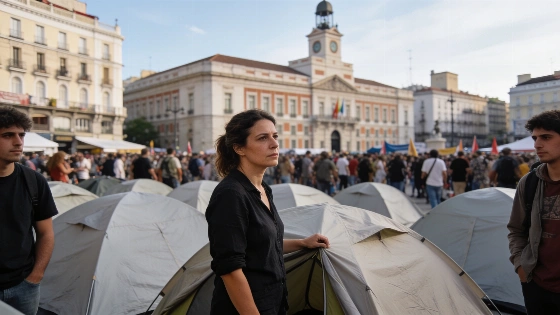
Dozens of tents remain at Madrid's Puerta del Sol as tenants demand indefinite rental contracts and automatic renewal. The campaign is pressing the government before Tuesday's Cabinet meeting.
Dozens of tents remain at Madrid's Puerta del Sol, where tenants are pressing the Government to approve a "decreto Maricarmen" at Tuesday's Council of Ministers meeting. The proposal would introduce indefinite rental contracts and automatic renewal. Alicia del Río, spokesperson for the Sindicato de Inquilinas de Madrid, says the measure is needed to protect stable lives and treat housing as a right. Her appeal puts Pedro Sánchez and the PSOE at the centre of a dispute over rental security.
This is still a demand, not a policy change. Tenants want the Government to decide whether renters can build their lives without losing their homes when a contract ends.
The current debate is linked to Spain’s 1985 Boyer decree, which ended mandatory indefinite renewal for new rental contracts. Tenant groups now want stronger long-term stability to be restored through new legislation.
Del Río says refusing indefinite contracts makes stable family life harder. She has asked why the PSOE would oppose agreements that let children stay with the same school group and give households more certainty. Her criticism reaches beyond tenants. She also pointed to support from people with mortgages and homeowners who want safer conditions for their children.
The union says the campaign reaches further.
For now, the camp will stay. Its stated purpose is to defend housing as a right and turn public frustration into a demand for dignified lives. The protest joins a specific legal request with a wider rejection of housing insecurity.
Reports from Ara and Democrata describe dozens of tents remaining in Puerta del Sol at least until Tuesday, while activists have also discussed creating camps in other cities. The action is therefore intended as a continuing pressure campaign rather than a one-day demonstration.
The setting gives the dispute a clear public face. The Puerta del Sol camp took place at the same time as an education demonstration, so both mobilisations met in a packed square, according to the information accompanying the event. Housing and education shared the scene. The camp's central demand stayed the same: stronger rental protection.
The proposed "decreto Maricarmen" is the immediate focus. RTVE's account of the union's presentation says the package goes beyond indefinite renewal. It includes measures against evictions, changes to rental legislation, rules for seasonal and room rentals, and a freeze on increases to existing rents. Del Río wants the Council of Ministers to include indefinite contracts instead of leaving automatic renewal outside the measure.
The campaign takes its name from the eviction of 87-year-old Maricarmen. Organisers present her case as a sign of the risks faced by tenants when a long-standing housing arrangement ends. BBC Mundo reported that the case was shaped by the legal limits of the old "renta antigua" regime. Other legal analyses have pointed to the 1994 Urban Tenancies Law and rules on inheritance or subrogation of rental contracts. The Government has not announced the requested change. The demand remains a proposal, and the camp remains an active protest.
The dispute also tests the gap between the Government's progressive identity and the union's expectations. Del Río has said a government that claims that identity loses its purpose if it does not defend stable lives through housing policy. The criticism is political. Its practical point is simple: renters face uncertainty, while the union wants a permanent contractual safeguard.
The camp's message is narrower than a general complaint about rent. It identifies the contract as the point where insecurity begins. The earlier camp report described protesters seeking measures against evictions. The current demand focuses on automatic renewal and indefinite agreements. La Razón and OKDiario cited critics who say linking Maricarmen's case directly to the current Government oversimplifies a dispute rooted in older rules and the court's legal assessment of the contract. The Government faces a specific test on Tuesday. The camp will keep pressing its case in public. The report is by David Romero González.