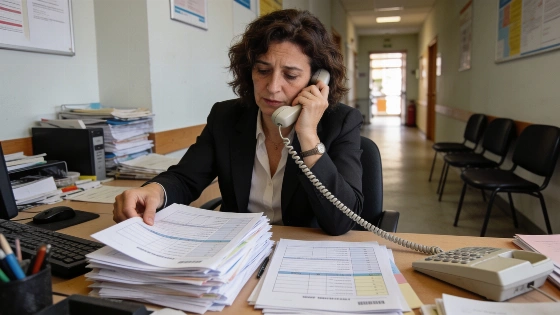
A quarter of Madrid’s official language schools are missing key administrative staff. Directors are left to handle enrolments and paperwork themselves, leading to a sharp drop in student numbers and growing frustration among teachers.
Madrid’s official language schools have started the academic year in disarray. In nine out of thirty-five centres, directors have had to step away from their teaching and management duties to cover empty administrative desks. With no secretarial or support staff, management teams are left to process enrolments, answer student queries, and handle paperwork—work that normally falls outside their job.
The effects are immediate. At the Escuela Oficial de Idiomas (EOI) in Alcorcón, the director now spends her days answering phones and sorting registration forms. She calls the situation “desperate” and “exhausting.” Three out of four administrative jobs have been vacant for months, and the school’s ability to serve students has collapsed. “We are not able to provide proper attention to students,” she says. Enrolment is already down by 200 compared to previous years.
According to the CCOO union, 61% of public education centres in Madrid began the 2026/27 school year with incomplete staff, and 41% had not received the promised teaching contingent as of September.
Other schools in Aranjuez, Coslada, Embajadores, Las Rozas, Parla, Villaverde, Vallecas, and San Blas report similar problems. Some directors are working twelve-hour days just to keep up with paperwork and student requests. One administrator, who asked not to be named, warns that the crisis could have lasting effects: “With 300 fewer students than usual, we risk losing entire language groups, which means fewer teachers and even lower enrolment in the future. It’s a domino effect.”
The regional government says it is working to fill vacancies, claiming new positions have been announced and that every effort is being made to cover absences. But directors say they mostly get automated replies and empty promises. In some schools, the entire secretarial staff has been missing since last year, and requests for urgent replacements have gone unanswered. “We were clear about our situation and asked for help by September 1, but nothing has changed,” says one member of a management team, who also notes that five teaching posts remain unfilled at her school.
Official regional data shows that the total number of teachers in Madrid's public centres increased by 1,280 for the 2026/27 academic year, reaching 68,899, with an additional 673 educators for students with special needs. However, this overall growth has not resolved local staffing shortages, especially in language schools, where administrative and teaching vacancies remain acute.
The union CSIF says the shortage of administrative staff is a widespread problem in Madrid’s public education sector, but language schools are among the hardest hit. Of the 217 administrative posts offered in late August, only 14 were for language schools. The union says it will monitor the situation to make sure promised interim appointments actually happen.
The start of classes on September 8 has only made things harder. With 40% of enrolments usually processed throughout September, directors are now juggling last-minute schedule changes, withdrawals, and complaints from students whose teachers have not yet been assigned. The paperwork backlog is growing, and the risk of more group closures is real.
Caridad Baena, vice president of the Madrid Association of EOI Teachers, calls the situation “unacceptable,” pointing out that some schools have been without secretaries for over a year. She says the regional Education Department does not understand the unique administrative needs of language schools, which are different from secondary schools. Luis Zambrano of CC OO agrees, calling for immediate action to activate hiring pools, set deadlines for filling vacancies, and create direct communication between schools and territorial management.
Madrid’s language schools are not the only ones struggling at the start of the academic year. As reported earlier, other schools in the region have faced safety and staffing problems, adding to the sense of instability for students and families.
The result is a public education system under strain, where chronic understaffing and slow bureaucracy threaten adult language learning in Madrid. Government assurances have not translated into real help, and directors and teachers are left to keep schools running however they can. Unless the administration delivers real solutions soon, enrolment, teaching quality, and public trust will continue to suffer.