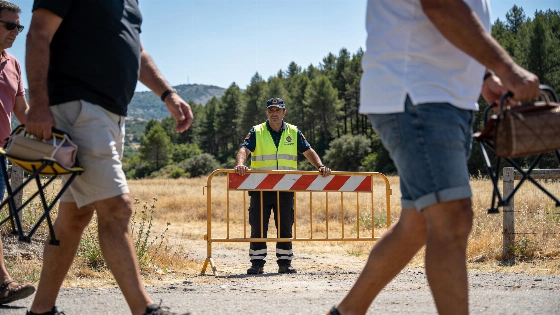
Several Madrid municipalities have cancelled public eclipse events due to wildfire risk. Only 30 out of 52 towns submitted emergency plans. Local authorities and residents express concern over safety and crowd management.
Madrid’s plans for mass public solar eclipse events have been thrown into disarray as wildfire risks force cancellations across the region. With the Sierra Oeste still battling active fires and the threat of new outbreaks high, only 30 of the 52 municipalities originally scheduled to host eclipse gatherings have submitted the required emergency plans and will proceed with their activities, according to ASEM 112 and the Firefighters’ Union.
The city of Tres Cantos, governed by the Partido Popular, was the first to withdraw. The municipality, which last year suffered a devastating fire that claimed a worker’s life and destroyed 1,700 hectares, had planned a large-scale event at Valdeloshielos, featuring live music, food trucks, and workshops. The decision to cancel, described by local officials as difficult but necessary, comes amid heightened fire alerts and extreme temperatures. Elisa Lidia Miguel, the councillor for Culture and acting mayor on the eclipse day, explained that the safety of residents and the environment outweighed months of preparation. She emphasized that no vehicles will be allowed at Valdeloshielos, though individuals may still visit on foot at their own risk, and urged the public to act responsibly to prevent any incidents.
Concerns are particularly acute in the Sierra Norte, where the best eclipse visibility is expected and where 17 observation points could attract up to 40,000 visitors, based on local estimates. The platform Monte en Pie, formed after a recent fire in Lozoyela and the Cinco Villas, has called for the cancellation of all events in or near forested areas. The group argues that organizing gatherings in such locations is irresponsible and has requested detailed emergency plans from 17 municipalities, but reports receiving vague or incomplete responses. Their spokesperson, Ignacio Martínez, highlighted the risk posed by visitors venturing into remote areas, potentially blocking emergency access and increasing the chance of new fires.
Emergency services are under strain, with the Firefighters’ Union warning that any incident could overwhelm already exhausted crews. ASEM 112 has activated the Platercam civil protection plan at its lowest level and reinforced emergency resources, but the regional government has left final decisions to local authorities. Most events are now planned for urban areas, and the regional festival at the Riosequillo pools in Buitrago del Lozoya will go ahead with controlled entry. The government continues to urge the public to avoid risky behavior, such as discarding flammable objects or disturbing natural habitats, and to respect all safety measures in place.
Madrid’s approach to managing large-scale public events under risk conditions echoes challenges seen in other Spanish regions, where authorities have had to balance public interest with safety concerns. For example, recent festival preparations in Barcelona’s Gràcia district also faced heightened security and heat-related measures, as detailed in coverage of the Gràcia Festival’s security and heat precautions. These cases highlight the growing complexity of organizing mass gatherings during periods of environmental risk.
Spain’s vulnerability to wildfires has increased in recent years, with climate change contributing to longer, hotter summers and drier conditions. The Sierra Oeste alone has seen over 27,000 hectares burned this season, and the region’s open landscapes make it especially susceptible. Local authorities are under pressure to ensure that emergency protocols are robust and that public safety is prioritized over tourism or economic interests. The ongoing debate over the eclipse events underscores the tension between community celebration and environmental responsibility in a changing climate.