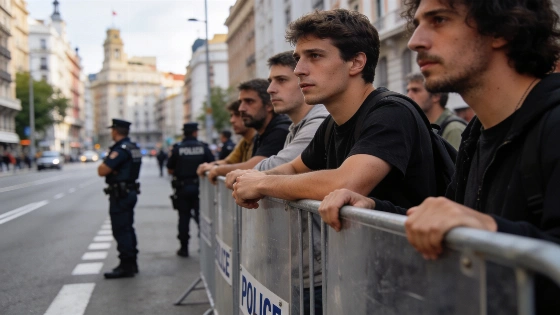
A Madrid protest called for early elections and Pedro Sánchez's resignation over the Ceuta crisis. Police stopped a group moving towards La Moncloa, while a laSexta Xplica crew was attacked during the march.
The march began in Plaza de Cibeles and ended at the Arco del Triunfo. Police later stopped a group that tried to move towards La Moncloa. The protest was organised by supporters of Sociedad Civil Española and focused on the Government's handling of the crisis in Ceuta.
The Delegación del Gobierno put the crowd at 20,000 people. Organisers claimed 180,000. The numbers conflict. Protesters called for Pedro Sánchez to leave office and repeated slogans accusing him of betraying the nation.
Акция стала второй «Marcha por la Dignidad», организованной Sociedad Civil Española в поддержку Сеуты и против миграционной политики правительства.
The attempt to reach La Moncloa brought the clearest confrontation of the day. A police barrier blocked the group and kept it away from the Government headquarters. EFE and RTVE reported that the march as a whole ended without serious incidents.
The political message went beyond a demand for an early vote. The manifesto called for the militarisation of Ceuta and the expulsion to Morocco of what it described as all the "invaders". It also demanded immediate elections with guarantees that the process would be clean. Organisers chose not to read the document at the closing rally.
The text accused the Government of helping to dismantle Spain. Some of its strongest attacks were aimed at La Moncloa. Chants called for Sánchez to go to prison. Others insisted that Ceuta should endure and that Spain was not for sale.
Поводом для акции стал кризис в Сеуте после массового прибытия мигрантов в конце июля. По сообщениям Euronews и Hespress, испанские власти оценивали число прибывших 30–31 июля в 70 000–80 000 человек.
Santiago Abascal and Miguel Tellado brought a separate dispute between Vox and the PP into the march. Abascal urged the PP to support his request to activate Article 102 of the Constitution. He said the measure should allow the prime minister to be tried for treason. Tellado rejected that position and pointed to the criminal investigation already under way. He said the judicial process should be allowed to work. Ahram Online and Telemadrid described the exchange as a visible split between the two opposition parties.
Abascal also attacked José María Aznar. The former prime minister had praised Alberto Núñez Feijóo's patriotism and criticised Vox. Abascal called Aznar defeated by Morocco and told Feijóo to find a better political mentor. The dispute turned a joint appearance into an argument over Ceuta and the opposition's direction.
Most of the march was peaceful. The treatment of the laSexta Xplica reporter was a serious exception. Several protesters pushed and shook her as she recorded. One tried to take her microphone. Others directed insults and threats at her. The aggression stopped her from completing her work.
The protest produced a large mobilisation around Ceuta and elections. It also exposed the split between the PP and Vox over the political and legal response. The disputed attendance figures show how differently each side framed the size of the crowd.
The police intervention at La Moncloa and the attack on the laSexta team added direct confrontations to an event presented as peaceful. The demand for elections was weakened by the PP's refusal to support Abascal's legal request and by the aggression against a journalist. The two opposition parties also failed to present a common position on Ceuta. The Government continues to seek measures aimed at restoring normality in Ceuta. Migration policy and responsibility for the crisis remain a sharp source of disagreement between the PP and Vox.