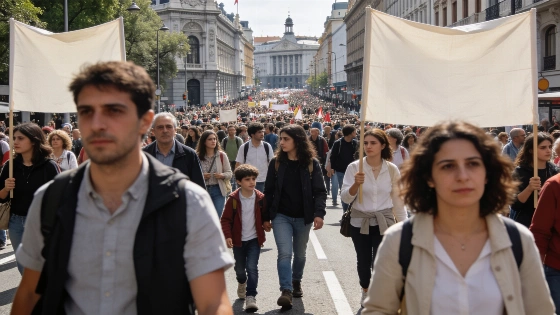
Around 10,000 people marched through Madrid on 27 September in support of public education. Teachers, students, families and unions are calling for lower workloads, smaller classes and higher pay before an indefinite strike planned for 14 October.
The march began at Atocha and ended at Puerta del Sol on 27 September. Around 10,000 people took part, according to the Government Delegation. Teachers, students, families and education organisations joined the protest.
The groups are demanding lower teaching loads, smaller classes and better pay. An indefinite strike is planned for 14 October. Madrid's regional government calls the action political and unnecessary.
The protest was organised by the Unified Strike Committee of Public Education in Madrid. Its slogan was "Salvemos la pública". The coalition brought together UGT, CC.OO., CNT, CONFAPA Madrid and FAPA Giner de los Ríos.
The march also passed a camp where hundreds of people had spent the night protesting the housing crisis. The camp stood near Sol. The wider setting gave the education protest a broader social backdrop.
The mobilisation brought together trade unions, parent organisations and student groups, including UGT, CC.OO., CNT, CONFAPA Madrid and FAPA Giner de los Ríos.
The main dispute concerns teaching time. The organisations want a return to a maximum of 17 teaching periods a week in Secondary Education and Vocational Training. The limit they seek for Primary Education is 22 periods.
They also want tutoring, department leadership and coordination duties counted in that total. The groups say formal teaching periods do not show the full workload. Preparation, coordination and pastoral work take additional time.
That is the core issue.
Aida San Millán, secretary general of the Madrid Education Federation of CC.OO., said teachers had lost 21.9% of their purchasing power since 2010. She called for a €600 monthly salary increase to the regional supplement.
San Millán said staff need enough income to live in the region and to bring their pay closer to levels in other parts of Spain. Europa Press reported both the salary demand and the estimate of lost purchasing power.
The unions have also set out target class sizes: 13 pupils in Infantil, 15 in Primaria, 20 in Secundaria, 23 in Bachillerato and 15 in Formación Profesional.
Class sizes are another demand. The unions want 13 pupils in Infantil, 15 in Primaria, 20 in Secundaria, 23 in Bachillerato and 15 in Formación Profesional.
UGT spokesman Chema Pinto focused on school segregation. He described it as the highest in Spain and called for a public school system that protects equal opportunities.
His argument was direct. Inequalities present when pupils enter education should not stay in place or grow during their time at school. The unions link that problem to resources and support for increasingly diverse classrooms.
The Sindicato de Estudiantes is calling for a wider mobilisation. Its spokesman Carlos Ochoa urged working families to join the strike and demonstrations. He presented the dispute as a defence of a social achievement that affects the whole working class, not only young people or education workers.
Mercedes Zarzalejo, counsellor for Education, Science and Universities of the Community of Madrid, rejected that view. She called the non-university public education strike political and unnecessary.
Zarzalejo said pupils, teachers and families were being used as hostages. She also linked the call to unions associated with political parties.
The two sides are now focused on teaching periods, pay and class sizes. The unions are preparing for an indefinite stoppage from 14 October. The regional government says the action is not driven by educational need.
La Razón described the 27 September march as a prelude to the planned open-ended strike. Público also reported on the breadth of the organising committee.
The scale of Sunday's march gives the unions a visible platform before the planned strike. The Government Delegation's estimate of 10,000 participants does not settle the policy dispute. It does show the size of the mobilisation in Madrid.
elDiario.es placed the demonstration within a wider campaign involving teachers, students and families in defence of public education.
The dispute now has precise numbers attached to it. The unions have set out limits for teaching time, class sizes and pay. The regional government has challenged the strike's legitimacy.
If the 14 October action goes ahead on the announced scale, state schools may feel the impact most sharply in Secundaria, Bachillerato and Formación Profesional. The next step is clear.