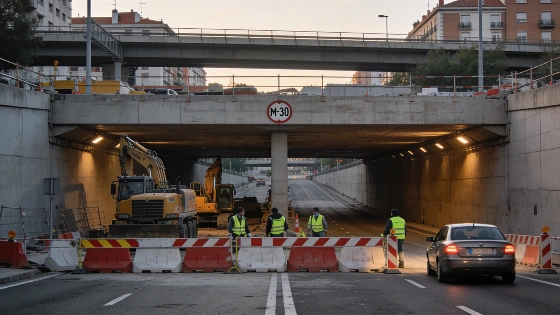
Madrid will shut the M-30 tunnel towards Badajoz from August 3 to 24. The closure is needed to connect the new A-5 tunnel. Drivers face major detours and traffic changes during the works.
Madrid faces a significant traffic disruption this August as the city prepares to fully close the M-30 tunnel in the direction of Badajoz, starting August 3 and lasting until August 24. The closure, announced by the Ayuntamiento de Madrid, is a critical step in the ongoing project to bury the urban section of the A-5 and link it with the existing M-30 tunnel beneath Avenida de Portugal. This move is essential for advancing the future Paseo Verde del Suroeste, a major urban redevelopment initiative.
The works will focus on demolishing the concrete slab of the current M-30 tunnel exit ramp, excavating to the required depth, and constructing a new slab that will connect the existing ring road tunnel with the new Paseo Verde del Suroeste gallery. The slab, which had been kept in place to maintain a temporary traffic diversion, will now be removed to allow completion of the permanent structure. Once the demolition is finished, crews will rebuild the structure, restore the fill, and set up a new provisional diversion to keep traffic flowing as construction continues.
Another key phase involves the nighttime installation of 14 massive beams, each 30 meters long, spanning the full width between the north and south abutments. This operation, requiring the entire width of the M-30 tunnel in both directions, will take place over four consecutive nights from August 10 to 13. During this period, the tunnel will be completely inaccessible to vehicles heading from the M-30 towards the A-5, with the exit at Casa de Campo closed off. The same restriction applies to the M-30 interior towards the A-5 outbound.
To mitigate the impact on drivers, the city’s Urban Planning, Environment and Mobility Department, led by Borja Carabante, has mapped out alternative routes. For long-distance journeys from Madrid to nearby municipalities, drivers can use the A-42 or Vía Lusitana to reach the M-40, or exit via General Ricardos to access Avenida de los Poblados. Vehicles coming from the north of the M-30 are advised to connect via the A-6, which links to the M-40 and then to the A-5 at Cuatro Vientos. Local residents have specific detour options, including the 19A exit from M-30 north via Paseo Marqués de Monistrol, Paseo de Extremadura, and Avenida de Portugal; from Puente de Segovia through Saavedra Fajardo, Pablo Casals, and Sepúlveda streets; or from Glorieta de Puerta de Toledo via Paseo de los Pontones, Puente de San Isidro, Vía Carpetana, and Concejal Francisco José Jiménez Martín street.
The current works on the northbound tunnel mirror those carried out last summer on the southbound tunnel, which required a closure twice as long, from July 18 to August 31. Civil engineering on the new tunnel is expected to finish in September, after which the Paseo Verde del Suroeste will begin to take shape at street level. By the end of the year, Madrid plans to open the new tunnel, finally burying a highway that has divided the neighborhoods of Lucero, Aluche, Las Águilas, Campamento, and Casa de Campo since 1968. The A-5 corridor currently sees an average of 80,000 vehicles daily.
The project’s budget stands at €347.4 million for the tunnel works, with an additional €57.8 million allocated for surface urbanization. The Ministry of Housing will cover the cost of the second phase of the underground project, which is still pending tender, with €146 million earmarked for the section beyond Campamento and €8 million for a future transport interchange in the area.
Madrid’s approach to large-scale infrastructure upgrades echoes similar urban renewal efforts seen in other Spanish cities. For example, Valencia recently launched a major housing and infrastructure plan in La Torre following severe floods, as detailed in this report on new public housing and safety measures. Such projects highlight the growing focus on reconnecting neighborhoods and improving urban mobility across Spain.
These extensive works on the M-30 and A-5 are part of a broader trend in Spanish cities to modernize transport infrastructure, reduce surface traffic, and create more livable urban environments. The completion of the Paseo Verde del Suroeste is expected to bring lasting changes to Madrid’s southwest, improving connectivity and quality of life for thousands of residents.