A gravel road in Maine has quietly tested a radical solution for frost damage since 1992. Engineers buried thousands of shredded tyres beneath the surface, tracking the results for decades. The findings challenge easy assumptions about recycling and infrastructure.
On a quiet stretch of Dingley Road in Richmond, Maine, there’s an experiment underfoot that’s lasted longer than most infrastructure trends. In 1992, engineers buried about 20,000 shredded tyres beneath the gravel, hoping to protect the road from the freeze-thaw cycles that usually tear up rural roads in the area.
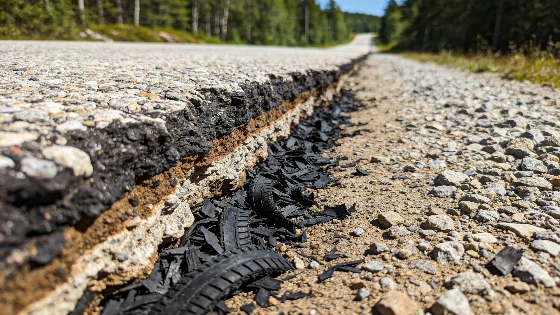
This wasn’t a case of hiding waste. The project was a deliberate test: could tyre-derived aggregate work as insulation? Every layer and measurement was planned out. The tyres were shredded into pieces no bigger than 51 millimetres, then laid in two thicknesses—152 and 305 millimetres—before being covered with up to 610 millimetres of gravel. The aim was to keep frost from reaching deep into the roadbed and causing the upheaval that comes with spring thaws.
The Dingley Road test section was about 600 feet long, with shredded tyres cut into 2–3 inch pieces and placed in layers 6–12 inches thick beneath the gravel.
Early news stories in 1993 claimed a dramatic 50 percent drop in frost depth after the first winter. But when civil engineer Dana N. Humphrey and Army researcher Robert A. Eaton published their technical report in 1995, the results were more measured. Over two winters, the thickest tyre layers reduced frost depth by 15 to 37 percent, while thinner sections saw 22 to 28 percent reductions. The best-insulated parts of the road had heave as low as 10 millimetres, compared to 91 millimetres in untreated areas.
For the 29 homes and two farms that depend on Dingley Road, the change was noticeable. Residents had dealt with deep ruts and mud every spring for years. The tyre insulation didn’t solve everything, but it made the road more reliable through Maine’s toughest months.
Even with these results, the approach never caught on widely. The US Environmental Protection Agency points out that tyre-derived aggregate (TDA) can work as a lightweight, draining fill in certain situations, but it’s not a cure-all. Its environmental impact depends on local soil, water, and pH, and it’s rarely cheaper than standard materials unless there’s a specific need. Reports of internal heating in the mid-1990s led to stricter design rules, making clear that careful engineering is essential.
According to technical reviews of the Dingley Road project, the experiment was not intended as a waste disposal method but as a controlled engineering study by Dana N. Humphrey and Robert A. Eaton to evaluate tyre-derived aggregate as a lightweight, insulating, and draining material for cold, weak soils. Later publications in the 2010s highlighted the continued relevance of TDA for soft subgrades and embankments, though its use remains limited to specific cases.
Some recent articles have mistakenly described the Maine project as something new or suggested that similar trials are just starting. In fact, the original construction finished on September 2, 1992, and the well-known North Yarmouth asphalt test wrapped up decades ago, with environmental monitoring continuing into the late 1990s. Studies found no significant leaching of heavy metals or salts from the tyre fragments, though there were occasional spikes in iron and manganese—enough to warn against blanket claims of safety.
Turning old tyres into roadbeds isn’t a quick fix for waste. It takes careful engineering, ongoing monitoring, and an acceptance that results will vary from place to place. The Maine experiment is a rare, long-term look at circular economy ideas in practice—one that brought real, if limited, benefits to a specific community.
Dingley Road’s hidden tyre layer doesn’t have the drama of epic journeys like those reported earlier, but its quiet endurance offers a different lesson. Real progress in infrastructure comes from steady data, adjustments, and honest evaluation of what works—and what doesn’t. The Maine road’s story isn’t a revolution, but a reminder that innovation in public works is rarely as simple as burying yesterday’s problems beneath tomorrow’s solutions.