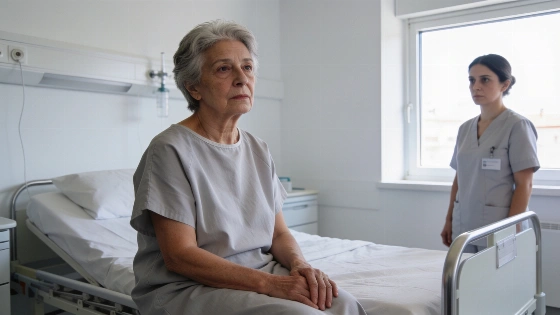
Evicted from her longtime home, 87-year-old Maricarmen remains in a Madrid hospital and keeps saying no to a city-run residence. Her case has set off political fights and left her future up in the air, even as officials say help is still on the table.
Maricarmen, 87, is now at the heart of a heated dispute in Madrid. After being evicted, she landed in the hospital and has refused the city’s offer of a spot in a municipal residence. She is still in a room at Gregorio Marañón Hospital. No one knows what she will do next.
The city council says her place in one of Madrid’s three municipal residences is still waiting for her. “She decides,” officials keep repeating. But Maricarmen has not accepted. There is talk she might move in with relatives, but nothing is settled. For now, she is not willing to go into institutional care. She lives with a 50% disability and wants to keep her independence.
Maricarmen was evacuated from her home on a stretcher by emergency services and taken directly to Hospital Gregorio Marañón after the eviction was carried out in the Retiro district, where she had lived for over 70 years.
Her health took a hit after the eviction. She suffered exhaustion, anxiety, and stress, which led to her being hospitalized. While she recovers, city social services have listed all the help they can give: teleassistance, 90 hours a week of home help, occupational therapy, preventive physiotherapy, and psychological care from both district and citywide teams. Still, none of these options have solved the main problem—where Maricarmen will go next.
The political fight has only grown. Protests against her eviction have continued. From New York, Prime Minister Pedro Sánchez blamed both the Community and the City of Madrid, calling out Ayuso and Almeida by name. Madrid’s vice-mayor Inma Sanz fired back, saying, “We have been the only ones who have taken care of her during this time,” and accused the national government of doing nothing. Sanz also said the eviction was legal, pointing to the PSOE’s Ley Boyer, and questioned whether national housing policies work.
City agencies like Samur-Protección Civil and Samur Social are still in touch with the hospital. They are ready to step in if Maricarmen changes her mind about the residence. The city keeps repeating its message: the offer stands, but the choice is hers.
According to several major Spanish media outlets, the eviction sparked mass protests, with hundreds gathering outside Maricarmen's home. Police cordoned off the area, and tenant organizations reported forceful dispersal and the use of irritant substances during the operation.
Her case has brought up bigger questions about social care and housing policy in Spain. It recalls other high-profile disputes, like those over unaccompanied minors in Ceuta, as reported earlier. But Maricarmen’s story is different because of its personal side and the political storm it has set off in Madrid.
This is a clash between personal choice and the system’s response. The city has put its resources on the table and says it has done its job. But Maricarmen’s refusal to take the official offer shows the limits of what bureaucracy can do when someone wants to decide for themselves or stay close to family. Her story shows that even the best social safety nets can fall short if they do not fit the real needs and wishes of the people they are meant to help.