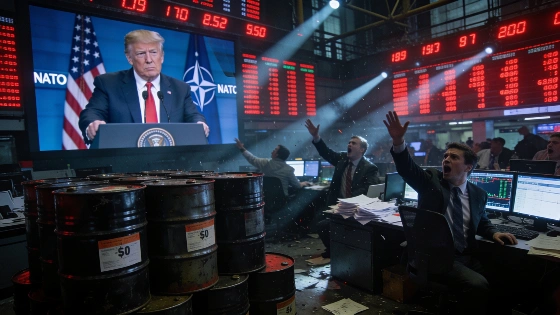
Stock futures tumbled after Donald Trump declared the Iran ceasefire over at the NATO summit. US strikes in response to attacks in the Strait of Hormuz pushed oil prices up. European markets and most sectors also fell.
Global financial markets faced a sharp downturn on Wednesday after US President Donald Trump announced at the NATO summit in Ankara that the ceasefire with Iran had ended. The statement came amid renewed hostilities in the Middle East, prompting a swift reaction from investors and sending oil prices soaring. Futures on the Dow Jones Industrial Average dropped by 705 points, or 1.3%, while S&P 500 and Nasdaq 100 futures also recorded significant losses. European indices followed suit, with the Stoxx 600 falling 1.8% and most sectors, except oil and gas, moving into negative territory.
The escalation followed US military action late Tuesday, when American forces launched a series of strikes against Iran. According to US Central Command, these operations were in retaliation for attacks on three commercial vessels in the Strait of Hormuz. In parallel, the US Treasury revoked a license that had allowed Iran to sell oil internationally, further tightening economic pressure on Tehran. Iran's foreign ministry condemned the strikes, calling them a violation of the Memorandum of Understanding reached with Washington the previous month, and warned that its armed forces would defend the country's sovereignty against further aggression.
At the NATO summit, Secretary General Mark Rutte described the US response as necessary, citing Iran's alleged breach of the ceasefire following the attacks on shipping. He emphasized the importance of a forceful reaction to maintain security in the region. The renewed conflict has unsettled investors, who had previously grown accustomed to a period of relative calm and were pricing in a gradual de-escalation between the US and Iran. Market analysts noted that the latest developments have forced a reassessment of geopolitical risks, with the prospect of a lasting agreement between the two countries now appearing uncertain.
Oil markets reacted immediately to the news. International Brent crude futures surged nearly 6% to $78.54 per barrel, while West Texas Intermediate climbed to $74.75, also up 6%. The spike in energy prices added to the pressure on global equities, particularly in Europe, where only oil and gas stocks managed to avoid losses. The situation has also drawn attention to the upcoming release of the Federal Open Market Committee's June meeting minutes, which could provide further direction for markets. The minutes are expected to shed light on Federal Reserve Chairman Kevin Warsh's first policy meeting, where officials left interest rates unchanged but signaled possible future hikes if inflation persists.
For Spain and other European economies, the renewed instability in the Middle East and the resulting volatility in energy markets may have direct consequences. Spain, as a significant importer of oil, is sensitive to fluctuations in global prices, which can impact transport costs, inflation, and broader economic stability. The Strait of Hormuz remains a critical chokepoint for global oil shipments, and any sustained disruption could affect supply chains across Europe. In recent years, Spanish authorities have monitored developments in the region closely, given the potential for rapid changes in energy costs to influence domestic prices and economic planning. The current situation underscores the interconnectedness of geopolitical events and their immediate impact on European markets and households.