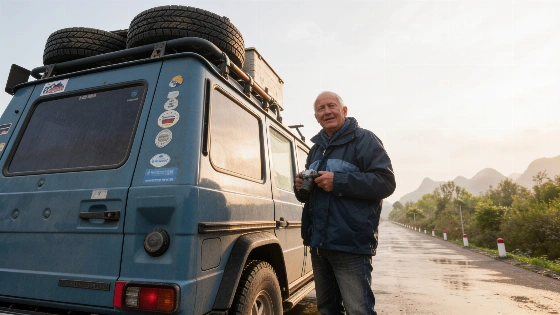
A Mercedes G Wagon named Otto became the most traveled car in history after Gunter Holtorf and his wife Christine spent 23 years crossing 179 countries and covering 885000 kilometers without sponsors or modern tech.
When Gunter Holtorf rolled his battered Mercedes G Wagon through Berlin’s Brandenburg Gate in 2014, the odometer showed 885,000 kilometers. What began as a planned 18-month road trip turned into a 23-year journey across 179 countries. Otto—the couple’s 1988 Mercedes G—became the most widely traveled car on record. According to Museum of Travel, Holtorf finished his trip on October 16, 2014, after visiting 179 countries and covering about 900,000 kilometers, a distance now officially recognized.
Few cars have been driven so far, or so hard, by their owners. Holtorf and his wife Christine set out after the Berlin Wall fell, first aiming for Africa. Instead, they ended up circling the globe, relying on paper maps, a few spare parts, and a camera. They had no sponsors, no GPS, and no social media—just determination and a diesel engine with 88 horsepower. The trip, which started in 1989, was supposed to last 18 months but stretched into decades, as confirmed by Museum of Travel.
After completing the journey, Otto became a permanent exhibit at the Mercedes-Benz Museum in Stuttgart, officially recognized for its unprecedented achievement.
Otto was never a showpiece. Before leaving, the Holtorfs took out the rear seats and put in mattresses, turning the G Wagon into a rolling home. "The main costs for travelers are hotels and restaurants. We skipped both. We slept in the car and cooked our own food," Gunter said. Their main expenses were fuel and an oil change every 5,000 kilometers.
Otto’s mechanical simplicity was its biggest advantage. With no electronics to fail, and a five-cylinder diesel engine, the car kept running through deserts, snow, and mud. "The car always started," Gunter recalled, even after countless flat tires and rough roads that would stop most modern SUVs. According to Museum of Travel, Otto finished the journey on its original engine, with about 400 spare parts carried along, and never suffered a major breakdown.
Some borders were tougher than others. Africa had "bridges that make your skin crawl" and roads that disappeared in floods. Still, the couple kept going, even managing to drive Otto into countries that are nearly closed to tourists, including North Korea—a move that reportedly surprised the German chancellor. Independent sources note that Holtorf also managed rare solo crossings of Myanmar and a 25,000 km drive across China, which he called "pioneer tours" because of the difficulty for foreign vehicles.
After starting the journey with another spouse, Holtorf later traveled with Christine, and following her death from cancer in 2010, he continued alone. This personal history is confirmed by independent biographical sources and adds depth to the motivation behind completing the expedition.
Museum of Travel
Christine’s death from cancer in 2010 was the hardest part of the trip. Before she died, she asked Gunter to keep going in her name. He did, driving on alone until Otto returned to Berlin. Today, the G Wagon stands in the Mercedes-Benz Museum in Stuttgart, preserved just as it finished—dust, dents, and all.
To put the distance in perspective, Otto covered enough ground to circle the planet more than 20 times. The feat overshadows most modern endurance drives, especially since there was no digital navigation or corporate support. As reported earlier, even the latest electric cars rarely face such relentless, real-world use.
Gunter Holtorf’s story shows that adventure depends less on horsepower and more on resolve. The Mercedes G Wagon’s reputation for toughness is deserved, but it was the couple’s discipline and resourcefulness that turned a simple road trip into a record. In a time obsessed with technology and comfort, Otto’s journey is a quiet argument for simplicity—and proof of what’s possible when you trust your machine and your own grit.