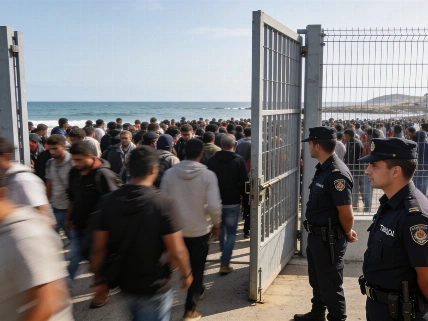
Ceuta’s migrant shelters remain only half full as many refuse to enter, fearing swift expulsion. Authorities expand accommodation, but distrust persists. The city’s daily life is marked by uncertainty and visible tension.
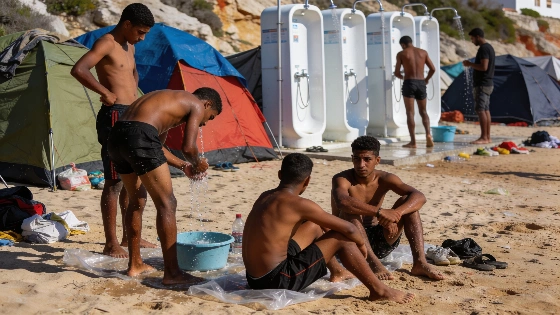
Ceuta’s efforts to restore order after the recent influx of migrants have met with limited success, as hundreds continue to avoid official shelters. Despite the opening of new accommodation spaces by the Ministry, the autonomous city, and local associations, many migrants remain wary, choosing to sleep outdoors rather than risk being easily located and expelled. The city’s main beach, El Trampolín, still hosts makeshift tents and groups of young men washing in temporary showers, while others seek shade nearby, reluctant to move into organized centers.
Authorities report that around 2,500 people are currently housed in official facilities, but a similar number continue to wander the city, often spending nights on plastic sheets by the roadside. Migrants from areas near Tangier and Tetouan openly express their suspicion, convinced that entering a shelter would make them more vulnerable to deportation. Some say they prefer the uncertainty of the streets, believing it offers a better chance to evade authorities if necessary.
One of the latest sites designated for migrant accommodation is the Hípica, a public-private equestrian club, which will soon host women and children. The decision has sparked visible opposition from club members, who have displayed their disapproval at the entrance. Meanwhile, the Centro de Estancia Temporal (CETI) has begun to fill with new arrivals, including young men like Jayte Balaar from Sudan, who says he is willing to wait as long as needed in hopes of reaching Madrid.
Conditions vary sharply across the city. In the industrial zone of El Tarajal, groups of young men gather among abandoned warehouses, venturing out only to collect daily food bags distributed by the Red Cross. Women, including relatives of some migrants, are mostly housed in a shelter in the La Reina neighborhood, where the atmosphere is reportedly less tense. According to the Ministry of Inclusion, Security and Migration, these women and children will soon be relocated to the Hípica facility, which is being prepared with donated carpets and plastic sheeting from local mosques and community groups.
Local residents remain divided. Some, like Mohamed, a long-time Ceuta shopkeeper, describe the situation as chaotic but note a slight improvement compared to the initial days. Tensions have also spilled into public life, with controversy erupting ahead of a football match between AD Ceuta and UD Las Palmas. The visiting team reversed its decision to wear shirts bearing the slogan ‘Ceuta no se vende, Ceuta se defiende’, reportedly due to concerns about possible repercussions during their return journey via Tetouan. The issue dominated conversations in bars near the stadium, reflecting the city’s unsettled mood.
Ceuta’s migrant situation is not unique. Similar challenges have been reported in recent months, with authorities across Spain seeking ways to manage arrivals and provide adequate shelter. For example, the government’s plan to transfer hundreds of vulnerable migrant girls from Ceuta to the mainland, as detailed in recent coverage of urgent relocation efforts, highlights the ongoing struggle to balance humanitarian needs with security concerns.
Ceuta’s geographic position at the edge of Europe has long made it a focal point for migration from North Africa. The city’s response to the current crisis underscores the complexity of managing large-scale arrivals, especially when trust between migrants and authorities is fragile. The reluctance of many to enter official shelters complicates efforts to provide basic services and maintain public order. As the situation evolves, the city faces continued pressure to find solutions that address both immediate needs and longer-term integration challenges.