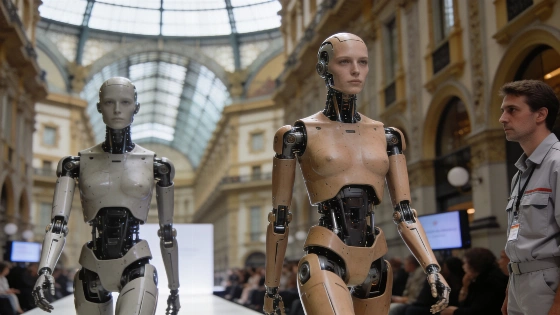
Milan Fashion Week opened with robots and AI-designed collections. Vogue World turned the Italian capital into a stage for a dispute over craftsmanship, automation and the future of creative work.
Robots replaced models on the Vogue World runway in Milan. Their appearance made fashion's technology debate impossible to ignore. The machines had no clothes because they are not yet humanoid enough to wear garments convincingly. Their presence turned a celebration of Italian craftsmanship into a test of whether automation can coexist with human creativity. Reports by People and the Free Press Journal identified the appearance as part of a segment linked to the "Age of Intelligence". That made the humanoid robots one of the evening's most discussed moments.
Vogue World chose Milan for its fifth edition after taking the show to New York, London, Paris and Los Angeles. The event took place in the Galleria Vittorio Emanuele. It traced Italian fashion from the Renaissance through later artistic movements before moving into an imagined future. Jennifer Lopez, Cardi B, Simone Ashley and J Balvin were among the stars who took part. Reports also mentioned MGK and other high-profile guests. Vogue World: Milano took place on 22 September 2026, in the Galleria Vittorio Emanuele II.
Vogue presented the 22 September 2026 show as an exploration of the human touch in an age of technology, with Italian craftsmanship, archival and contemporary looks, and a collaboration with the Teatro alla Scala choir at its centre.
The show's message centred on the phrase "Where the Future Is Made by the Hand". Anna Wintour presented Milan as a city that could modernise handmade work without losing its value. That idea met the robot sequence head-on. Technology was not working behind the scenes. It was the visible body on the catwalk. Vogue described the show as an homage to craftsmanship, fabric technologies and fashion's future, not as an attack on human work. That made the robots feel like a deliberate provocation within the larger story.
The contrast became sharper with Prada's opening collection. The label opened Milan Fashion Week's spring-summer 2027 schedule on the same day as Vogue World. The week ran from 22 to 28 September 2026.
Prada opened the spring-summer 2027 shows with designs that repeated one form in different colours. Its famous bags became small charms attached to clothing. They were a secondary detail, not the centre of the collection. The result offered little of the originality many expect from one of fashion's best-known houses. Reviews from FashionNetwork, SCMP, ELLE US and ELLE UK offered a fuller picture. They described the skirt, not the bag, as the collection's central element. They also pointed to bright shades, layering, decorative details and constructions that could be changed or worn in different ways, giving the collection a broader vocabulary than a strictly minimalist reading would suggest.
Prada’s spring-summer 2027 show comprised 63 looks. Coverage of the collection focused on the skirt in multiple iterations, while also noting vivid colours, layered silhouettes, decorative elements and details that could be transformed or reconfigured.
Lorenzo Bertelli, now president of Versace after its purchase by Prada, says artificial intelligence and automation should improve the tools available to artisans. They should not replace the experience those artisans bring to their work. That position matches Vogue World's stated goal of defending fatto a mano while letting new technology support craftsmanship. Macao Business also linked Bertelli's position to the idea that AI and automation should strengthen artisans' work, not displace it.
The industry's recent record makes that line harder to hold. Technology was already part of the wider Milan Fashion Week format before the Vogue World robots appeared. According to Outlook Luxe, the 22-28 September schedule included 54 physical shows and six digital presentations.
Theophilio's spring-summer 2026 collection was made entirely through artificial intelligence. The process ran from the first sketches to the textures developed before the clothes were produced. I.N OFFICIAL also worked with Meta on a collection imagined with AI during planning and design. It showed the collection at Africa Fashion Week London in August 2025.
Spain has its own example. Agatha Ruíz de la Prada said she used artificial intelligence to suggest designs for the firm's spring-summer 2026 collection. She then turned selected ideas into garments. She described the results as a mixture of unusable material and playful proposals that became inspiration. For her, the system was another tool, not the author of the work.
That distinction is now the industry's main fault line. AI can speed up processes, solve problems and save time. Each step toward automated design also makes authorship harder to pin down. It leaves less room to say where assistance ends and creation begins. The question is not whether the technology will enter fashion. Milan has already shown that it is there.
The real question is who keeps creative control when machines produce the first image, the texture and eventually the form of a garment. The evidence presented in Milan supports a clear conclusion. Technology can assist an artisan, but it cannot be allowed to turn human skill into decoration. An industry that celebrates the hand while quietly replacing its decisions would be defending a slogan, not a principle.