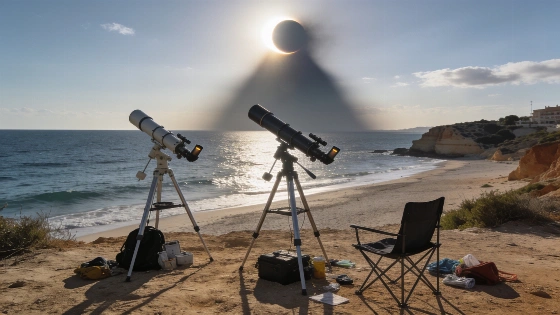
A total solar eclipse darkened much of Spain for the first time in over a century. From Galicia to Valencia, crowds gathered in diverse locations, facing both clear skies and cloud cover. The event drew families, tourists, and scientists.
Spain experienced a rare astronomical event as a total solar eclipse swept across the country, drawing millions to beaches, rural fields, historic castles, and official observation points. The phenomenon, visible from Galicia to the Valencian coast and the Balearic Islands, marked the first time in more than 100 years that such an eclipse crossed the peninsula. The spectacle unfolded around 20:30, with the sudden drop in temperature and the silvery twilight signaling the moment the Moon fully obscured the Sun.
In Galicia, the eclipse entered through Punta Herbosa in Mañón, A Coruña, where thousands gathered with protective glasses. While some locations enjoyed clear views, others, like Caión in A Laracha, faced persistent cloud cover that frustrated many who had traveled specifically for the event. Despite the weather, the sudden darkness and temperature shift left a strong impression, even when the Sun itself was hidden behind clouds. Local authorities in Caión prepared for an influx of visitors, deploying security and mobility measures as the small town braced for thousands of guests.
Further along the coast, Cedeira’s San Antón de Corveiro viewpoint offered clear skies and dramatic Atlantic views. Hundreds, including international visitors, watched as the eclipse reached totality for nearly two minutes. Children and adults alike expressed awe, though many wished the darkness had lasted longer. Inland, the valley of Sabero in León became a focal point for scientific observation, with around 500 people gathering at La Camperona. The town, with just 1,000 residents, had spent over a year preparing, hoping to boost scientific tourism in the region.
In Valladolid, the abandoned convent of San Bernardino in Cuenca de Campos hosted a smaller crowd, guided by an aerospace engineer who explained the science behind the eclipse. The event brought new attention to the historic site, as the sudden darkness moved some attendees to tears. Meanwhile, in San Sebastián de los Reyes near Madrid, the local football field became an official viewing area, attracting 18,000 people. The brief 33 seconds of totality were met with cheers and applause, as families and friends gathered on the grass, turning the event into a communal celebration.
Madrid’s eastern hills also filled with spectators, while the Observatorio Astronómico de Yebes in Guadalajara hosted the institutional center for the eclipse. Scientists, officials, and the public shared the moment, with the Ministry of Science emphasizing the importance of scientific outreach. The event included talks by astronauts and astronomers, and the observatory’s director expressed relief after months of preparation. For many scientists, witnessing a total eclipse was a long-awaited dream.
In Teruel’s Sierra de Javalambre, the European Space Agency broadcast the eclipse worldwide from the observatory, joined by Nobel laureates and astrophysicists. The sky turned pink and the temperature dropped sharply, prompting applause and quiet reflection among those present. Nearby, the Galáctica center welcomed families and tourists, with organizers describing the eclipse as a cosmic dance between the Sun, Moon, and Earth.
In Móra la Nova, Tarragona, visitors endured 37-degree heat to witness the eclipse from one of the Generalitat’s official points. The crowd included both locals and international guests, some traveling hundreds of kilometers for the occasion. Stories of past eclipses were shared among families, highlighting the generational impact of such rare events.
Valencia’s Malva-rosa beach became the largest urban gathering point, with thousands arriving early to secure a view. The low position of the Sun made observation challenging, leading some to seek out rooftops or terraces, which reportedly rented for high prices. Authorities closed natural parks due to fire risk, pushing many to the beaches and surrounding countryside. For a brief moment, birds fell silent as darkness swept over the city.
Safety remained a priority throughout Spain, with officials reminding the public of the risks of improper viewing. As highlighted in guidance on eclipse safety measures, removing protective glasses too soon can cause lasting eye damage, a message reinforced by local authorities during the event.
Total solar eclipses are rare in Spain, with the last crossing the peninsula over a century ago. Such events not only offer a unique spectacle but also foster scientific interest and community gatherings. The next opportunity for a similar experience in Spain is not expected for many decades, making this eclipse a memorable occasion for all who witnessed it.