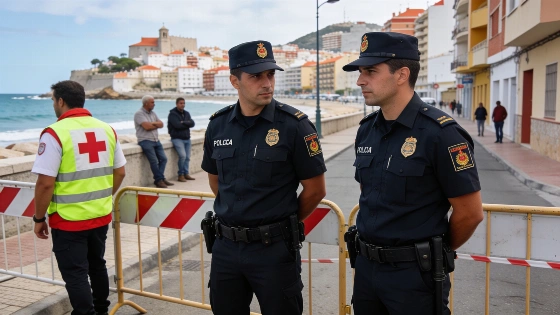
Ceuta remains unsettled nearly a month after 80,000 migrants arrived. Minister Torres promises to speed up the process of restoring order. Political divisions and practical challenges complicate the response.
Ceuta continues to grapple with instability weeks after the sudden arrival of 80,000 migrants, as the city faces ongoing protests and security incidents. On Thursday, Minister of Territorial Policy Ángel Víctor Torres, who leads the government’s unified command in the region, announced a commitment to accelerate efforts to restore normality. Addressing the National Security Joint Committee, Torres called for cross-party cooperation and condemned recent violence, emphasizing that attacks against Muslim residents, migrants, Red Cross volunteers, or journalists are unacceptable.
Torres outlined the government’s response since the unified command was established, but cautioned that immediate mass returns of migrants are not possible. He stressed that while the government is determined to ensure the return of those who entered irregularly, the process requires time and cannot be completed overnight. This position aligns with recent legal developments, as Spain’s Supreme Court has ruled that each case involving migrant minors must be reviewed individually, blocking collective deportations—a decision detailed in a recent analysis of the legal barriers to mass returns.
Political tensions surfaced during the committee session. Cristina Díaz Moreno, senator for the Partido Popular, criticized the government for lacking a concrete plan and accused it of allowing what she described as an “invasion” to escalate into a crisis of public order. She demanded that Prime Minister Pedro Sánchez take political responsibility. In contrast, Sumar’s Txema Guijarro challenged the use of the term “invasion,” arguing it misrepresents the situation.
Other parties raised practical concerns. Mikel Legarda of the PNV highlighted the urgent need for suitable accommodation for migrants, noting that many proposed facilities lack basic infrastructure and will take months to prepare. The use of sports halls as temporary shelters was ruled out by Torres, who clarified that such measures were only intended for extreme, unforeseen circumstances and that the relevant decree allows for flexibility.
ERC’s Francec-Marc Álvaro expressed regret that decisive action was not taken sooner, while Junts’ Josep Pallès argued that Catalonia is already hosting more migrant minors than its share and should not be expected to compensate for what he called government mismanagement. Torres, in turn, urged all parties to support the distribution of minors, warning that opposing it ignores Ceuta’s needs.
The session also saw heated exchanges between Vox’s José María Sánchez and Minister Félix Bolaños, with Sánchez responding to earlier accusations by Bolaños with personal insults. Despite objections from some deputies, the committee chair defended Sánchez’s right to free expression.
Ceuta’s situation remains complex, with authorities balancing humanitarian obligations, legal constraints, and local tensions. The city’s experience reflects broader challenges facing Spain’s migration policy, especially regarding the care and legal status of minors. The government’s approach is shaped by both immediate security concerns and the need to comply with judicial rulings that protect the rights of vulnerable groups. As the process of restoring order continues, the effectiveness of these measures will be closely watched across Spain.