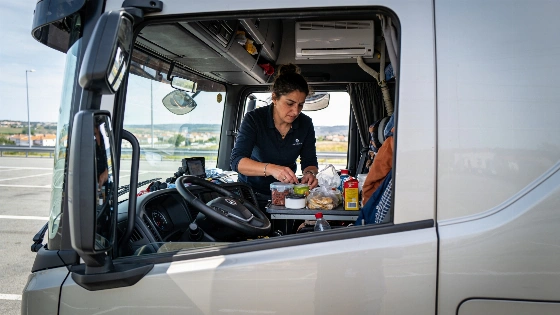
Miriam spends up to 24 days at a time living in her truck, navigating Europe’s highways and the realities of a male-dominated industry. Her story reveals the discipline, language skills, and sacrifices required to keep goods moving across borders.
For Miriam, the cab of her truck is more than just a workspace—it’s her kitchen, living room, and bedroom for nearly a month at a stretch. As an international truck driver, she routinely spends between 22 and 24 consecutive days on the road, crossing European borders while her Spanish accent and daily habits remain unchanged. “I have to optimize every minute,” she says, describing a lifestyle where routine and order are not just preferences, but survival tools.
Returning home, Miriam faces a different challenge: time. In quieter months, she might have three or four days to rest before heading out again. During peak periods, that window shrinks to just two weeks a year. The relentless schedule leaves little room for friends or downtime, making every hour at home precious.
Through her social media presence as @lachicacamionera, Miriam shares stories from the road, offering a candid look at the realities of European freight transport. Her followers see not only the long hours and logistical hurdles, but also the strategies she uses to cope. One key: meticulous planning. Rather than improvising, she stocks up at the supermarket before returning home, ensuring she can make the most of her limited time off.
But domestic organization is only part of the equation. For Miriam, mastering English is as essential as knowing her route. “Download apps and start practicing English today,” she urges those entering the industry. Her experience driving through France, Germany, Poland, Ireland, Italy, and Spain has shown her that English is the common language at loading docks and offices across the continent.
Despite her experience, Miriam still relies heavily on her co-driver for communication, often turning to her phone’s translator app to get through paperwork and conversations. This dependence slows her down and complicates even routine tasks, highlighting a practical barrier for many drivers in the sector.
Miriam’s journey stands out in a field still dominated by men, though the gender gap is slowly narrowing. By sharing her story and advice online, she not only brings visibility to women in transport but also encourages others to consider a career behind the wheel. Her experience echoes that of other women who have entered the industry, such as those who have rebuilt their lives in Spain’s trucking sector—like the story of a Venezuelan engineer who found a new path as a national driver, detailed in this report on career change and adaptation.
According to elespanol motor, Miriam’s story is a reminder of the discipline, adaptability, and resilience required to succeed in international transport. While the sector is evolving, the demands remain high—and for drivers like Miriam, every journey is a test of both skill and endurance.
Contextually, Spain’s logistics industry is a vital part of the European supply chain, with thousands of drivers covering millions of kilometers each year. Language barriers, long absences from home, and the need for constant organization are common challenges. As more women enter the field, stories like Miriam’s are helping to reshape perceptions and open doors for the next generation of drivers.