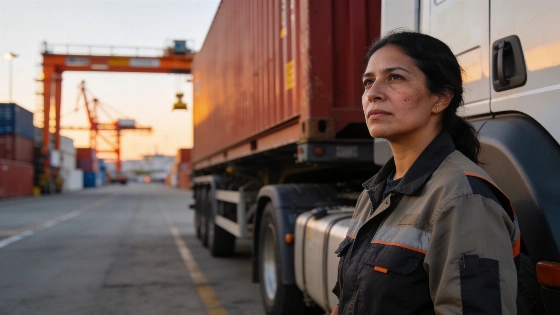
Sandra Ruiz left a senior engineering role in Venezuela to start over as a truck driver in Spain. Her journey reveals the challenges and trade-offs of entering a male-dominated field—and why she values coming home every night.
Sandra Ruiz once managed a railway station in Venezuela. Today, she navigates the busy roads of Valencia as a national truck driver—a transformation shaped by necessity, resilience, and a willingness to start from scratch. Forced to leave her homeland in 2017 due to Venezuela’s economic collapse, Ruiz first landed in the Dominican Republic, where she struggled to find work in her field. Spain soon became her next destination, though she arrived with little knowledge of the country’s climate or job market.
Her early months in Spain were marked by financial strain and uncertainty. Ruiz survived on minimal income during the pandemic, working as a telemarketer for just €1,000 a month. The turning point came when her partner, already a truck driver, suggested she join the industry. Despite her initial hesitation—“In my country, it’s unusual for women to do men’s jobs,” she recalled—Ruiz invested €8,000 of her savings to obtain the necessary driving licenses. The process was far from straightforward: long waiting lists in Valencia forced her to travel to Extremadura to complete her training.
Ruiz’s first experience was in international freight, working “a dobles” with her then-partner. The grueling schedule—up to 21 hours of availability and only four hours of rest in the cab—quickly took its toll. While she discovered a genuine interest in trucking, the strain of working and living in close quarters led to the end of her relationship. “I like what I do, but not the company,” she admitted. Searching for solo work, Ruiz encountered both skepticism and curiosity from employers—some reluctant to hire a woman, others intrigued by her profile. “It’s a matter of luck and contacts,” she explained.
Her breakthrough came via a Facebook ad: a Valencia-based employer offered her a chance to drive container trucks. The first month was overwhelming, with daily tears as she struggled with complex maneuvers at the port. Swallowing her pride, Ruiz sought help from colleagues and gradually mastered the skills required. After a stint in international night transport, she chose to specialize in daytime container work at the Port of Valencia, prioritizing quality of life over maximum earnings. The port’s 8 p.m. closing time means she returns home every evening—a rare privilege in the sector.
National truck drivers in Spain can earn up to €3,000 a month, but often at the cost of long absences from home. Ruiz accepted a lower net salary—between €1,800 and €2,000—in exchange for daily family life. Her story echoes the experiences of other women breaking into Spain’s transport industry, such as those highlighted in reports on women who left low-wage jobs for trucking.
As noted by elespanol motor, Ruiz’s journey underscores both the barriers and opportunities facing women in Spanish logistics. While the sector remains male-dominated, stories like hers point to gradual change—and the personal choices behind every career move. For many, the real measure of success is not just the paycheck, but the ability to build a stable life in a new country.