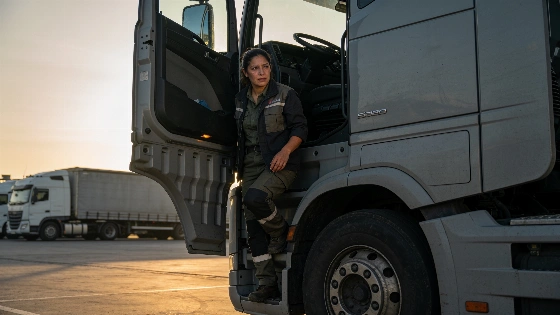
Rosa left a poorly paid textile job in Murcia to become a truck driver, seeking better pay and time with her daughter. Her move highlights the challenges and rewards for women in Spain’s male-dominated transport sector.
When Rosa steps down from her Ford 500 truck after a night shift, she often hears the same remark: “I could never do your job.” Born in Ecuador and raised in Spain from the age of nine, Rosa spent years working in a textile factory in Murcia, earning just €1,200 a month. The work was grueling, the atmosphere tense, and the pay barely covered her bills. For Rosa, the turning point came when her brother, already established in the transport industry, encouraged her to consider trucking as a way out.
Getting behind the wheel was not immediate. Rosa invested around €4,000 and waited a year to obtain her commercial license, slowed by a shortage of examiners. Her first job took her across Europe, with international routes that kept her away from home for weeks at a time. The pay was better—€1,700 a month—but the cost was high: she saw her daughter only every other weekend. “When you start, you earn very little,” she recalls. “I like my job, but it took a lot of trial and error to find the right fit.”
Determined to be present for her daughter, Rosa switched to regional transport. The reality, however, was far from ideal. She worked late afternoons into the night, often waiting for hours at loading docks, sometimes not returning home until dawn. The unpredictable hours left her feeling guilty for missing time with her child, and the emotional strain nearly drove her to quit.
Refusing to give up, Rosa found a new opportunity: night shifts delivering for Mercadona, one of Spain’s largest supermarket chains. The schedule finally allowed her to return home every morning, offering a rare balance between work and family. Her earnings now range from €1,700 to €2,300 a month, nearly double her factory wage. “I have flexibility to adjust my hours,” she says. “It’s made a huge difference for my family life.”
Rosa’s story is not unique. The number of women in Spain’s trucking industry remains small, but their presence is growing. As highlighted in coverage of other female drivers breaking into the sector, the path is rarely easy. Long hours, unpredictable schedules, and a male-dominated environment are common hurdles. Yet for those like Rosa, the rewards—financial stability and the ability to shape their own routines—can outweigh the challenges.
According to elespanol motor, the demand for regional and night drivers continues to rise, especially among logistics giants like Mercadona. For many women, trucking offers a practical route to higher pay and greater autonomy, even if the road to get there is far from straightforward.