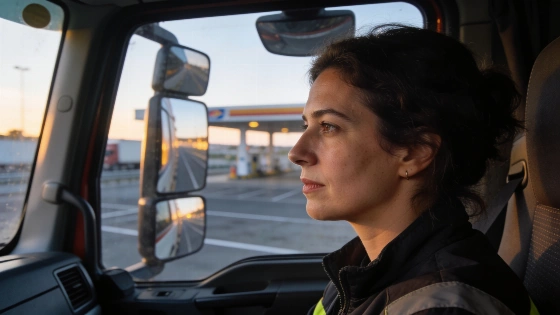
María Dolores has spent 11 years behind the wheel of a truck, navigating long routes and a male-dominated industry. Her story highlights the daily challenges and persistent gender gap in Spain’s transport sector.
When María Dolores climbs into her truck each Sunday afternoon, she knows the week ahead will blur into a relentless stretch of highways, loading docks, and fleeting rest stops. With 11 years of experience, she is part of a rare group: just 2% of Spain’s 250,000 professional truck drivers are women, despite over 25,000 women holding the necessary licenses. For Dolores, the job is not a choice but a necessity. “It’s tough, but I have no other option than to get in the truck,” she admits, capturing the reality faced by many women in the sector.
Her daily routine is shaped by the demands of the supply chain, not personal preference. Starting routes on Sundays is standard, not optional. “You have to leave Sunday afternoon to sleep at your destination and avoid using up your Monday driving hours,” she explains in her candid social media posts. The workweek stretches endlessly, often making it hard to keep track of the days. For Dolores, weekends with family are a rare luxury, sacrificed to keep goods moving across the country.
The gender imbalance in Spanish transport is stark. According to the Ministry of Transport and Sustainable Mobility, women now make up 43.4% of all licensed drivers in Spain—over 12 million people. Yet in the world of professional trucking, their presence remains minimal. Social attitudes have been slow to change: a 2026 Midas survey found that 83.5% of Spaniards believe prejudices persist about women’s driving abilities, and nearly half still find it unusual to see a woman behind the wheel of a heavy vehicle.
Dolores has felt this scrutiny firsthand. Early in her career, she recalls the stares and questions that came simply because she was a woman in the cab. “If I were a man, they wouldn’t ask me these things,” she notes, emphasizing that professionalism—not gender—should matter. Her openness on social media and in the documentary short “Ellas conducen” has brought visibility to the realities women face in the industry, from isolation on the road to the challenge of balancing work and family.
Despite the obstacles, Dolores’s presence on Spain’s highways is quietly transformative. Each kilometer she drives not only delivers goods but also chips away at the barriers for women who may follow. Her story echoes that of other trailblazers, such as Spain’s youngest female truck driver, Andrea García Cano, who are challenging stereotypes and opening doors in logistics.
As noted by elespanol motor, the slow but steady increase in women entering the transport sector signals a gradual shift. However, the numbers show that true parity remains distant. For now, drivers like María Dolores continue to shoulder the weight of both their cargo and the expectations of a changing industry.
Context: Spain’s transport sector is one of the country’s largest employers, but remains heavily male-dominated. Initiatives to attract more women have emerged in recent years, yet cultural and practical barriers persist. The experiences of drivers like Dolores highlight both the progress made and the distance still to go.