Wafae Atid, 28, left Morocco for Ceuta over ideological differences, not economic hardship. She cites gender inequality and limited freedom as basic factors behind her decision.
Wafae Atid says returning to Morocco is out of the question. The 28-year-old Moroccan woman in Ceuta rejects the country’s mentality and social norms. Her story, reported by EL PAÍS, reflects migration driven by ideological differences and the pursuit of personal freedom, rather than economic hardship.
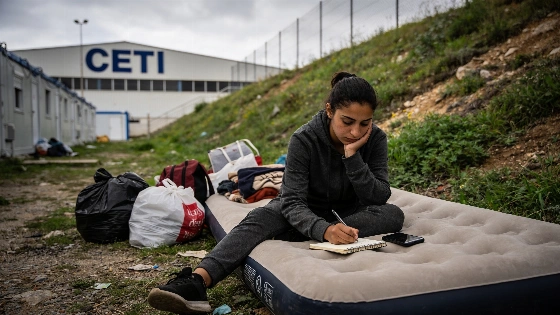
Atid has spent more than two weeks sleeping on an inflatable mattress near Ceuta’s Centre for the Temporary Stay of Immigrants (CETI), hoping to secure a place inside. She says poverty did not lead her from Morocco. Instead, she points to gender inequality and restrictive rules: women remain subordinate to men, she says, while social expectations limit personal liberties, including the freedom to play sports or live without religious constraints.
Raised in the Taza region near the Rif, Atid broke away from her family after being pulled out of school and pressured to adopt religious practices she did not accept. She later worked as a receptionist, learned English and traveled through several countries in the Middle East and Africa, including a period living in the United Arab Emirates. Bureaucratic barriers and financial requirements blocked her efforts to secure visas for Europe or the Gulf, eventually leading her to risk swimming into Ceuta.
Her account comes amid a broader migration emergency that began on 30-31 July 2026, when more than 70,000 people crossed or attempted to cross from Morocco into the Spanish enclave by land and sea. Most returned to Morocco within hours, while thousands remained, including unaccompanied minors. The arrivals strained accommodation and asylum services, leaving some people in makeshift camps or dependent on charities and civil-society groups.
While waiting outside the CETI, Atid studies Spanish with a mobile app and writes phrases in a notebook. She hopes to reach Barcelona and settle in Spain, where she believes she can find respect and freedom. Her time in Ceuta coincided with demonstrations by hundreds of migrants on a beach in August, demanding access to asylum procedures instead of immediate return to Morocco. The Spanish government later cleared at least one beach camp and moved groups into temporary accommodation, although Reuters reported that a union representative estimated roughly 7,000-8,000 people remained scattered across the city or in crowded facilities run by charities and civil-society organizations.
The government reported that more than 12,700 people had returned to Morocco between 10 August and 20 October 2026, and said most adult migrants still in Ceuta had been placed in facilities provided by the General State Administration. The official figures and the union estimate offer different pictures of the accommodation situation. Spanish authorities have said that removal and international-protection cases must follow the procedures and safeguards required by Spanish and European law, with each case considered individually rather than handled through automatic mass returns.
Spain’s Interior Minister, Fernando Grande-Marlaska, said returns were voluntary and told Reuters: “There are no covert deportations under any circumstances.” The distinction between return procedures and protection claims matters to people who say they left because of discrimination or restrictions on personal autonomy, not economic hardship alone.
Atid’s experience is marked by isolation and uncertainty. She arrived in Ceuta alone, fears harassment and remains wary of moving to women’s shelters because she is concerned about deportation. She has tried to reconnect with her family in Morocco, but deep differences in values and expectations persist, particularly over religious observance and women’s roles.
Gender inequality and access to education are part of the wider context in Morocco. The country’s official statistics agency, the Haut-Commissariat au Plan, reported that in 2025, 55% of girls aged 15-17 in rural areas were enrolled in school, compared with 100% in urban areas. Morocco’s National Human Rights Council has also said unequal inheritance rules contribute to women’s poverty. These conditions help frame the issues Atid describes, though her account remains her own.
Unaccompanied minors have also featured in protection discussions in Ceuta. On 21 October 2026, Spain’s Minister for Youth and Children, Sira Rego, met with UNHCR to discuss minors who might qualify for asylum or other international protection. The ministry said some had protection profiles linked to their countries of origin and that several belonged to the LGTBIQA+ community. More than 70 lawyers in Ceuta had received UNHCR training on immigration and child-protection law ahead of screening procedures linked to the European Pact on Migration and Asylum. Rego described transferring minors to mainland Spain as the most effective way to protect them and ease pressure on Ceuta.
Atid’s case reflects migration driven by personal convictions and the search for autonomy, alongside economic motives. The situation in Ceuta feeds wider debates about integration, asylum and the challenges faced by people whose reasons for leaving do not fit a narrow economic profile. Her journey puts questions of dignity in the context of ideology and identity.
Stories of migration and family dynamics have also drawn attention elsewhere, including when the Jordanian royal family gathered for a rare private moment to welcome Princess Iman’s twin daughters, as reported in this coverage of a royal family event.
Ceuta, a Spanish enclave on the North African coast, has long been a focal point for migration from Morocco and beyond. The CETI provides temporary accommodation for migrants awaiting decisions on their status. Spanish authorities face continued pressure to balance humanitarian needs with border control as migration drivers diversify. Atid’s story brings the personal dimensions of these journeys into focus.