Fundación Ibercaja has completed Museo Goya’s expansion in Zaragoza. A new entrance, restored architecture and a major opening exhibition recast the visit around Francisco de Goya.
Work began after the museum closed in December 2024, keeping Museo Goya shut for 656 days. It reopened on 9 October 2026 with its floor area increased from 3,700 to 4,661 square metres.
The reopening also falls during the 150th anniversary of Fundación Ibercaja. The enlarged building now stretches across seven floors and gives the museum a more visible position in Zaragoza’s historic centre.
The museum remained closed for 656 days, and the completed building now extends across seven floors. The renovation therefore represents a full transformation rather than a simple refurbishment.
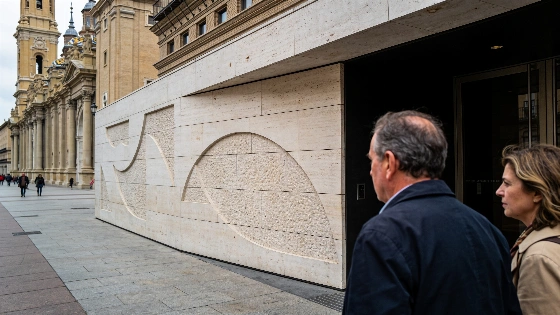
The most immediate change is outside. Visitors now enter from calle Santiago, near Plaza del Pilar, through a new stone façade. Its three-metre pieces evoke selected images from Goya’s best-known prints.
A large side screen will carry images, activities and other content. The museum’s central focus remains the art.
Sebastián Arquitectos led the architectural project, while EMPTY developed the museographic renewal and digital content. Wider, more accessible areas make movement through the building easier. According to Europa Press, the new interpretation also includes interactive elements. Immersive formats and virtual reality are part of the renewal.
The building’s own history now receives more attention.
At the upper level of the 16th-century house, the restored gallery of arches brings back one of the property’s most distinctive features. The new layout starts with works by Goya’s artistic predecessors, moves into rooms devoted to the Aragonese master and then reaches the renewed prints room. The route ends with painting and sculpture from the 19th and 20th centuries.
The expansion adds almost 1,000 square metres, including a 315-square-metre temporary-exhibition hall with a double-height space. The new capacity is intended to support major national and international projects, while the museum's new Francisco de Goya Research Centre strengthens its scientific and educational role.
The sequence gives the visit a clear historical direction. Visitors encounter the influences that came before Goya, his career and the artists who carried his impact into later generations.
A new area for educational activities extends the museum’s use to school groups. The collection should be easier to follow because the route now connects the artworks with the building around them.
The reopening is anchored by «Solo Goya. El arte de ver», an exhibition created for this new stage. Organised by Fundación Ibercaja and curated by Luis Fernández-Galiano, it brings together more than 40 works by Francisco de Goya from major museums and collections around the world.
The opening programme also presents the artist’s complete print series within the museum’s new exhibition policy. Many of the loans are being shown together for the first time. The exhibition remains open until 10 January.
During the closure, Fundación Ibercaja organised a travelling presentation in Huesca so the collection could remain accessible while construction continued. The project rebuilt the building, visitor route and interpretive system rather than applying a cosmetic update.
The new access on calle Santiago strengthens the museum’s relationship with Plaza del Pilar. Restored arches preserve the identity of the historic house.
José Luis Rodrigo, director of Fundación Ibercaja, has said the foundation acquired the neighbouring plot in advance with a view to further enlargement. The 2026 anniversary year was chosen as the target for this stage of the project.
Museo Goya opens Tuesday to Saturday from 10:00 to 20:00. On Sundays and public holidays, it opens from 10:00 to 14:00. The museum is closed on Mondays, while 12 October has special opening hours from 10:00 to 14:00. Further information is available through Museo Goya Fundación Ibercaja and Museo Camón Aznar at museogoya.fundacionibercaja.es.