Spain’s government has declared a national emergency in Madrid and Ávila due to severe wildfires. The move shifts operational control to the Interior Ministry and the UME. Political tensions over disaster management resurface.
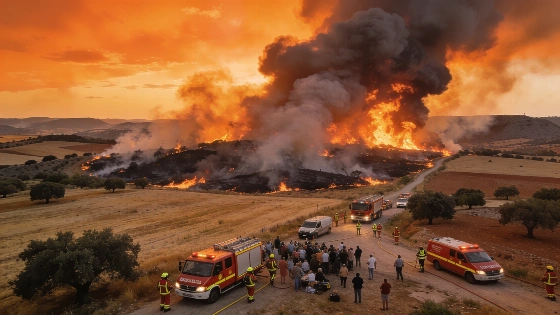
The Spanish government has declared a national emergency in the Community of Madrid and the province of Ávila following a rapid escalation of wildfires threatening populated areas and critical infrastructure. The decision, published in the Boletín Oficial del Estado, comes after a formal request from Madrid’s regional president, Isabel Díaz Ayuso, and extends to Ávila due to the cross-regional impact of the fires.
Authorities cited the simultaneous outbreaks in Villa del Prado and San Martín de Valdeiglesias (Madrid), as well as Burgohondo (Ávila), as creating an exceptionally dangerous situation. The fires’ swift spread, adverse weather, and the need for preventive evacuations prompted the government to activate level 3 of the national civil protection emergency system. This measure centralizes command under the Ministry of the Interior, with operational leadership assigned to the Unidad Militar de Emergencias (UME).
Ayuso’s public call for national intervention, made late Thursday via social media, highlighted the scale of the crisis and the strain on local resources. She warned of thousands evacuated and fires beyond local capacity, urging for reinforced national and even international support as weather conditions were expected to worsen. The government’s response, however, was not without controversy. Francisco Martín, the government’s delegate in Madrid, criticized the initial request as lacking detail, suggesting that such a serious appeal required more substantial justification than a brief letter and a tweet. Despite this, the central government moved forward with the emergency declaration, and Prime Minister Pedro Sánchez chaired a high-level coordination meeting on Friday.
The current situation has revived debate over how and when national emergencies are declared in Spain. In 2024, the devastating dana in Valencia, which claimed 237 lives, did not lead to a national emergency declaration. Then-regional president Carlos Mazón managed the crisis at level 2, retaining local command and requesting military support as needed. Initially, Mazón thanked the central government for its assistance, but as criticism mounted over his handling of the disaster, he shifted to accusing Madrid of delaying aid and using resource allocation for political leverage. The phrase “si quieren ayuda, que la pidan” became a flashpoint, with opposition leader Alberto Núñez Feijóo accusing Sánchez of lacking compassion, though the prime minister’s actual statement emphasized readiness to provide resources upon request.
Political disputes over disaster response have become a recurring theme. In the aftermath of the Valencia floods, the Partido Popular (PP) amplified criticism of the government’s approach, while internal divisions surfaced over whether a national emergency should have been declared. The issue resurfaced in April 2025 during the major blackout, when seven PP-led regions and one governed by the PSOE formally requested national emergency status, handing over operational control to the Interior Ministry to address widespread disruptions to infrastructure and essential services.
Spain’s legal framework for emergencies, established in 2015, sets clear criteria for when national coordination is required—typically when multiple regions are affected or when the scale of the crisis exceeds local capacity. The current wildfires meet both thresholds, justifying the government’s intervention. For context, similar tensions over central versus regional control have played out in other policy areas, such as energy and diplomatic relations, as seen when Madrid sought to restore ties with Algiers after a diplomatic rift, detailed in this report on Spain’s gas negotiations with Algeria.
Spain’s approach to emergency management continues to evolve, shaped by recent crises and political dynamics. The current fires in Madrid and Ávila underscore the challenges of coordinating rapid, large-scale responses across multiple jurisdictions, and the persistent friction between regional autonomy and national oversight. As the situation develops, the effectiveness of the centralized response will be closely watched, both for immediate outcomes and for its impact on future disaster policy.