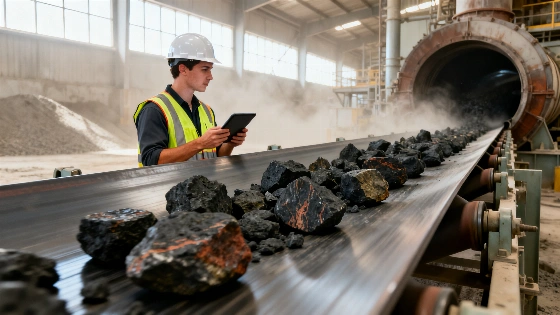
US Researchers Propose Cement Without Limestone: Opportunity to Cut CO₂ Emissions in Construction. American researchers have developed a method to produce Portland cement without limestone, using basalt as a substitute. This could reduce CO₂ emissions and lower energy consumption in construction. The key question is how feasible it is to introduce this technology in an industry where change comes slowly.
In the US, a group of scientists has proposed changing the very foundation of Portland cement production—replacing limestone with basalt and other silicate rocks. This step could radically reduce CO₂ emissions, which today are comparable to those of all the world's passenger cars. As Talent24h notes, it is the chemical composition of limestone that makes it the main source of carbon in the industry: when heated to 1500°C, it releases up to 500 kg of CO₂ per ton of cement.
A study led by Jeff Prancevic of the University of California, Santa Barbara, and Cody Finke of Brimstone Energy showed that if limestone is replaced with basalt or gabbro, it is possible to produce the same Portland cement but with much lower emissions. In theory, energy consumption is reduced by more than 40%, and CO₂ emissions—by 80%. Even using existing technologies and regular electricity, emission reductions can exceed 25%.
The key idea is not to invent a new material, but to change the source of calcium so as not to disrupt established construction processes. This is important for an industry where standards and technologies have been centered around classic Portland for decades. According to Prancevic, only this approach offers a chance for mass adoption: builders will not have to retrain, and the existing infrastructure will remain unchanged.
A comparison of the two approaches clearly demonstrates the difference: limestone requires high temperatures and produces large emissions, while basalt allows for lower energy and carbon costs. Moreover, basalt contains not only calcium but also iron and aluminum, which can be extracted as by-products, potentially making the process even more beneficial for industry.
However, the new technology faces clear obstacles. Limestone is cheap, and all the industry's regulations and logistics are set up for its use. The price of cement remains around 150 euros per ton, and any changes are viewed with caution. Therefore, as the study's authors emphasize, success is only possible if the familiar quality and properties of Portland are maintained—otherwise, the market simply will not accept the innovation.
The introduction of new technologies in construction is always met with industry inertia. As the experience of saving energy at home shows, even simple solutions, like changing a gas tariff, require time and effort—you can read more about this in the article on real savings on utility services.
If limestone-free cement technology proves effective on an industrial scale, it could become one of the most significant steps toward reducing the carbon footprint in construction in recent decades. For now, the industry is closely watching experiments and awaiting the first real implementations.