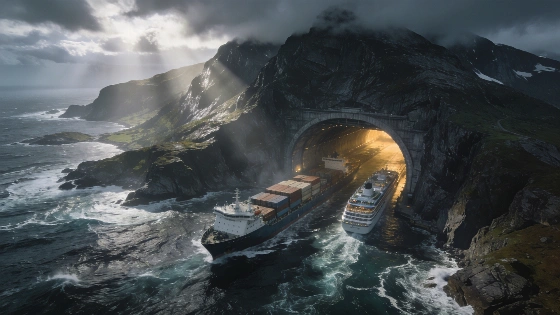
Norway has approved the construction of the Stad Ship Tunnel, a 1.7-kilometer maritime passage that will allow large vessels to safely cross the treacherous Stad Peninsula. Work is set to begin in early 2027, following a major contract award to AF Gruppen.
Norway has taken a decisive step toward transforming maritime navigation with the approval of the Stad Ship Tunnel, a groundbreaking project that will carve a 1.7-kilometer passage through solid rock beneath the Stad Peninsula. Designed to accommodate ferries, cargo ships, and passenger vessels, the tunnel will offer a safer alternative to the notoriously hazardous Stadhavet Sea, where frequent storms and lack of natural shelter have long disrupted shipping routes.
The Norwegian Coastal Administration has awarded the design and construction contract to AF Gruppen, with the agreement expected to be signed in August and construction scheduled to commence in early 2027. The tunnel will stretch between Kjødepollen in Vanylvsfjorden and Moldefjorden near Selje, with a total excavated length of 1,700 meters—expanding to 2,200 meters when including access and guiding structures at each portal.
Engineering on a Grand Scale
The scale of the Stad Ship Tunnel is unprecedented. The main gallery will measure 50 meters in height and 36 meters in width, providing 33 meters of clearance from the sea surface to the tunnel ceiling. These dimensions will allow passage for vessels as large as those operating on Norway’s Hurtigruten and Kystruten coastal routes, according to the Norwegian Coastal Administration (Kystverket).
To realize this vision, engineers will remove approximately 3 million cubic meters of rock—equivalent to 5.4 million cubic meters of blasted material, or around 750,000 truckloads. Conventional drilling and blasting methods will be used, and part of the excavated rock is earmarked for developing local industrial zones. The project also includes technical installations, interior defenses, dredging, and new commercial areas at the tunnel entrances.
Safer, More Reliable Shipping
The primary goal of the Stad Ship Tunnel is to enhance safety and predictability for maritime traffic along Norway’s exposed western coast. The Stadhavet Sea is considered the country’s most dangerous stretch of open water, with severe weather often forcing ships to wait hours or even days before continuing their journeys. By providing a sheltered route, the tunnel is expected to reduce delays, lower fuel consumption, and cut emissions by minimizing the need for ships to idle or reroute during storms.
While the tunnel’s technical and visual impact may attract international attention, its main function is practical: to serve Norway’s fishing, commercial, and passenger shipping sectors. The project is not intended as a tourist attraction, but its scale and ambition are likely to make it a landmark of modern engineering.
Budget Approval After Years of Delays
After years of studies, revisions, and cost-related postponements, the Norwegian Parliament unlocked the project on June 19 by approving a new P85 budget framework of 8.588 billion Norwegian kroner—about 760 million euros at the July 1 exchange rate. The main contract with AF Gruppen is valued at 5.6 billion kroner (excluding VAT) and covers both detailed design and construction. Before full-scale excavation begins, preparatory work will include site offices, worker accommodations, temporary roads, water pipelines, and necessary demolitions.
If the official timeline holds, construction will take around five years, opening a new chapter in maritime engineering and offering a safer passage through one of the North Atlantic’s most challenging corridors. The project’s ambition echoes other major European infrastructure efforts, such as Switzerland’s vast underground tunnel network that is reshaping freight transport across the Alps—a development explored in detail in this report on Switzerland’s subterranean transport revolution.
As Norway prepares to break ground on the Stad Ship Tunnel, the country positions itself at the forefront of maritime innovation, setting a precedent for how nations can address natural obstacles with bold engineering solutions.