The Orquestra Simfònica del Vallès launches its fortieth season with a record thirty concerts. The program features Beethoven, new commissions, and a surge in audience numbers. The anniversary brings fresh leadership and ambitious premieres.
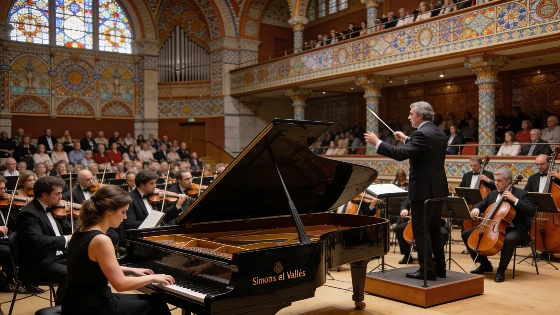
The Orquestra Simfònica del Vallès (OSV) is opening its fortieth season with a focus on change rather than nostalgia. This year, the orchestra is presenting its largest and most varied program so far at the Palau de la Música Catalana, mixing well-known works, premieres, and collaborations that cross genres. The season is officially the 31st "Simfònics al Palau" cycle and is dedicated to the OSV's 40th anniversary, with an emphasis on connecting major symphonic pieces, new works, and different stage formats.
Audience numbers are up. Last season, the OSV drew 39,000 people—8,000 more than the year before—filling 83% of seats on average and selling out seven concerts. Palau director Joan Oller presented these figures as evidence of the orchestra's recent growth and as a reason to take more risks with programming. These numbers are among the most reliable indicators of the institution's momentum, according to Catalan media reports.
The official opening concert on September 19 will feature not only Beethoven's 'Emperor' Concerto, but also works by Ryuichi Sakamoto, Lera Auerbach, and Tchaikovsky's '1812 Overture', as listed in the Palau's published program.
The season begins on September 19, with pianist Alba Ventura performing Beethoven’s ‘El emperador’ under conductor Andrés Salado. Ventura is playing with the OSV for the first time and has a personal history with the piece, having debuted with it at London’s Barbican twenty-five years ago. The official anniversary concert follows on September 28, marking the 150th anniversary of Pau Casals’s birth. The season runs through May, with 23 different programs and a record 30 concerts, as confirmed by the Palau and several Catalan news outlets.
The OSV is pushing beyond its usual territory. The program includes three world premieres and covers a wide range of music: Brahms’ ‘Danzas húngaras’, tributes to film composers Williams and Zimmer, a waltz festival, and Mozart’s ‘Misa de la coronación’ led by Xavier Puig. Opera and zarzuela are also featured, with performances of ‘L’elisir d’amore’, ‘Cavalleria rusticana’, ‘Pagliacci’, ‘Cançó d’amor i de guerra’, and ‘Aida’ scheduled throughout the season. The addition of opera and zarzuela broadens the cycle’s scope beyond just symphonic music, according to the official Palau program.
Leadership is changing along with the music. Andrés Salado remains principal conductor, joined by Noemí Pasquina as resident conductor and Isabel Rubio as associate conductor. Pasquina will lead the premiere of ‘La dansa del sabre’ by Miquel de Jorge, a piece inspired by Mercè Rodoreda’s poetry and featuring saxophonist Iñaki Bermúdez. The work is described by its creators as a musical “birth” and reflects the OSV’s interest in new voices and contemporary Catalan culture. The new leadership structure—Salado as chief conductor, Pasquina as resident conductor, and Rubio as associate conductor—has been officially confirmed for this anniversary season.
One of the season's main premieres, 'Albes i nits' by Miquel de Jorge for saxophone, orchestra, and children's choir, is scheduled for November 21. This demonstrates that new works are integrated throughout the entire cycle, not isolated in a single block.
Official Palau de la Música Catalana program
The season also experiments with format. ‘Beethoven & Mezquida’ features pianist Marco Mezquida reinterpreting Beethoven with improvisation, while multi-instrumentalist Abraham Cupeiro will premiere ‘L’ocell de foc’ by Stravinsky & Abraham Cupeiro using ancient instruments. These projects are meant to attract listeners who might not usually attend symphonic concerts. The season ends on May 29 with Gershwin's "An American in Paris" and two clarinet concertos—by Mozart and Artie Shaw—with soloist Carlos Ferreira, as listed in the Palau's official schedule.
One of the season’s more unusual events is on October 31, when the OSV will play Bernard Herrmann’s score live during a screening of Hitchcock’s ‘Psicosis’. The orchestra is also moving into pop and rock, with symphonic versions of songs by Queen, Bruce Springsteen, Pink Floyd, The Beatles, Donna Summer, and Gloria Gaynor, conducted by Isabel Rubio. This approach follows recent trends in Catalan music events, such as Aitana’s concert at Palau Sant Jordi, where language and identity were in focus.
The OSV’s plan is straightforward: broaden what a symphonic season can be, support new talent, and make the Palau de la Música a place for both tradition and new ideas. Nearly a third of the orchestra’s musicians are new this year, signaling a focus on renewal. This anniversary season is less about looking back and more about making sure the orchestra stays relevant for the next generation. The programming, audience growth, and leadership changes all show that the OSV wants to set the pace for Catalonia’s musical scene, not just celebrate its own history. Several Catalan media outlets have noted that the season’s official positioning and programming are designed to encourage a conversation between established repertoire and new creative work.