Oviedo’s mayor has come under intense criticism after downplaying a violent assault on two local activists during the San Mateo festival. His comments defending the alleged attackers have drawn sharp responses from the victims and left-wing groups, highlighting deep political divides in Asturias.
When Oviedo’s mayor, Alfredo Canteli, brushed off a violent attack on two activists as a minor incident, he did more than stir up local anger. His response exposed a deeper tension in Asturias’ political scene. The victims, Rubén Rosón and Jorge Fernández, were beaten by a group of eight during the city’s San Mateo celebrations. Instead of clearly condemning the violence, Canteli defended the alleged attackers, saying, "I don’t think they’re such bad people."
That comment quickly became a flashpoint. For the victims and their supporters, it felt like a blatant lack of empathy. "It’s inhuman, as if he has no heart," Rosón told elDiario.es, still recovering from head injuries and bruises. The attack happened in the middle of Oviedo’s festivities and targeted members of AMA Asturies, a group known for organizing alternative, community events. These events have often clashed with the city’s official agenda since Canteli’s administration began restricting them in 2021.
According to RTPA, Rosón required five stitches and suffered multiple head injuries and bruises as a result of the attack.
Rosón, a former city councillor and practicing doctor, described the violence plainly: "For what it could have been, we’re lucky to be alive. One wrong kick to the head and my colleague might not be here." He insists the attackers acted deliberately, vandalizing festival booths decorated with rainbow flags and anti-racist banners—symbols of Oviedo’s grassroots activism. "They came to destroy everything that stands for human rights," he said.
The mayor’s response has only made things worse. Instead of supporting the victims, Canteli’s remarks seemed to excuse the violence and even cast doubt on those attacked. "He tried to muddy the debate by attacking me personally," Rosón said, pointing to his own background in public healthcare. Canteli’s refusal to clearly condemn the assault has led to calls for the local and regional branches of the Partido Popular to distance themselves from his statements, and for national party leader Feijóo to clarify his position.
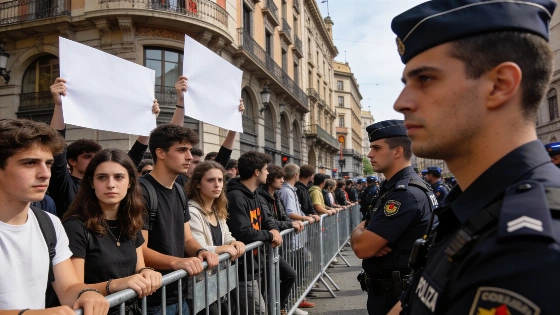
Public anger boiled over on Saturday, when thousands gathered in Oviedo’s Cathedral Square to protest the violence and demand accountability. The demonstration, organized by AMA Asturies and supported by the Asturian left, sent a clear message: fascist aggression will not be ignored. Meanwhile, the city’s right-wing parties have mostly stayed silent. Vox declined to specifically denounce the attack, instead releasing a generic statement against "all types of violence."
Local and regional media reported that, as of the days following the incident, no arrests had been made, though the victims filed official complaints with the Asturias police headquarters. The case is under investigation by the Policía Nacional, as confirmed by government delegate Adriana Lastra.
Rosón links the assault to a wider climate of hostility fueled by far-right rhetoric. He points to recent social media posts by Vox spokesperson Sonsoles Peralta, who publicly targeted the alternative festival booths, and to comments by Vox deputy José María Figaredo, who called for "hunting immigrants." According to Rosón, these messages embolden extremists and create an atmosphere where violence is tolerated. "This is what happens when hate is injected into society by political and media movements," he said.
The city’s campaign for European Capital of Culture 2031, built around the slogan ‘Amabilidá’ (Kindness), now seems out of touch. The attack happened in a square dominated by a giant banner promoting this very message. For Rosón, the contradiction is obvious: "The mayor’s words put the entire candidacy at risk. They go against everything these European distinctions stand for."
Despite the violence and political fallout, Rosón says he is trying to focus on hope. "We have an obligation to be optimistic, even after a beating," he said. "Asturias has always been a land of solidarity and human rights. That’s what we saw in the protest—thousands standing up for civic and social values."
What’s at stake is more than the safety of activists or the reputation of a festival. It’s about the moral credibility of Oviedo’s leadership. When those in power downplay violence and protect its perpetrators, they send a dangerous message about whose rights matter. Canteli’s refusal to clearly oppose fascist aggression is not just a political mistake—it is a failure of basic civic responsibility. In a city that claims to value kindness, silence from the top says more than any slogan.