Oviedo’s mayor faces public outrage after downplaying a violent assault during the San Mateo festivities. Victims and local groups accuse him of excusing far-right aggression, sparking protests and calls for accountability.
Oviedo’s mayor, Alfredo Canteli, is facing a wave of criticism after he downplayed a violent attack during the San Mateo celebrations, describing the alleged assailants as "not such bad people." His comments came just days after two members of AMA Asturies were beaten by a group of eight, drawing sharp condemnation from the victims and left-wing groups in the city.
The attack targeted Rubén Rosón, a former city councillor and doctor, and Jorge Fernández, both involved in organizing alternative, community-focused festivities. The assault happened in the city center, where both men were punched and kicked. Rosón needed stitches for a head wound, and Fernández was also hit in the head—a blow Rosón said could have been fatal. Local media and RPTA confirmed the incident took place on the night of September 11, 2026, during the San Mateo festival. Authorities are investigating it as a possible hate crime.
The initial conflict began when the attackers attempted to tear down a rainbow flag and an anti-racist poster at the Fiestes Populares booth, according to local news sources.
Instead of clearly condemning the violence, Canteli’s public statements seemed to defend the unidentified suspects. He suggested the attackers were not truly malicious, a position the victims called "inhuman" and lacking empathy. Rosón, who received many messages of support, said the mayor’s comments made light of the attack and failed to meet the responsibility of public officials to denounce such acts. As reported by La Voz de Asturias, Canteli said on September 13 that he did not know exactly what happened or who the attackers were, which led to further criticism for minimizing the seriousness of the assault.
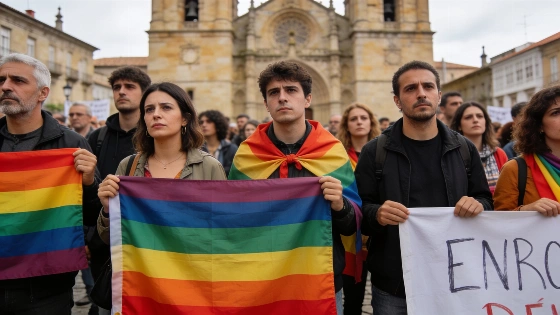
Thousands gathered in Oviedo’s Cathedral Square to protest both the attack and the mayor’s response. AMA Asturies and other left-wing groups organized the demonstration, which filled the square with people demanding a clear condemnation of the violence and an end to vague official statements.
Rosón linked the assault to a climate of hostility fueled by far-right rhetoric. He pointed to recent social media posts by Vox spokesperson Sonsoles Peralta, who criticized the alternative festival booths, and to inflammatory remarks by Vox deputy José María Figaredo. According to Rosón, these actions help create an environment where hate-driven violence is tolerated or encouraged.
IU Oviedo demanded a 'clear, forceful and unconditional' condemnation from Mayor Canteli, while the regional government delegate, Adriana Lastra, described the incident as a 'brutal ideological aggression' and confirmed that the Policía Nacional is leading the investigation.
La Voz de Asturias
The attackers reportedly targeted booths displaying rainbow flags and anti-racist banners, vandalizing spaces set up to defend human rights. Rosón argued that the real danger is not just the actions of eight people, but the broader political and media climate that encourages this kind of behavior. Vox did not specifically condemn the incident, instead releasing a general statement against "all types of violence."
For many in Oviedo, the mayor’s remarks have become a focal point in a wider debate about the role of public officials in confronting hate crimes. The victims and their supporters have called on the Partido Popular, both locally and nationally, to distance themselves from Canteli’s comments and show support for those attacked. They also want national party leader Feijóo to publicly reject the mayor’s stance.
The incident happened beneath a large city-sponsored banner promoting "Amabilidá," Oviedo’s campaign to become European Capital of Culture 2031. Rosón pointed out the irony, warning that the mayor’s attitude could hurt the city’s chances by contradicting the values of dialogue and inclusion that the campaign is supposed to represent.
Similar debates over political responsibility and public safety have surfaced elsewhere in Spain, such as a recent leadership dispute in Catalonia’s police force. These cases highlight growing scrutiny of how authorities respond to violence and the expectations placed on those in power to set a clear moral standard.
Oviedo’s recent events have become a test for Spanish democracy: whether elected leaders will confront hate-driven violence or avoid taking a stand. When a city’s top official downplays a violent attack, it signals not just a lack of empathy but a failure of civic duty. Refusing to clearly oppose political violence risks normalizing it and undermines public trust, as well as the values that campaigns like "Amabilidá" claim to uphold. The credibility of Oviedo’s institutions—and its hopes for European recognition—may depend on how its leaders respond.