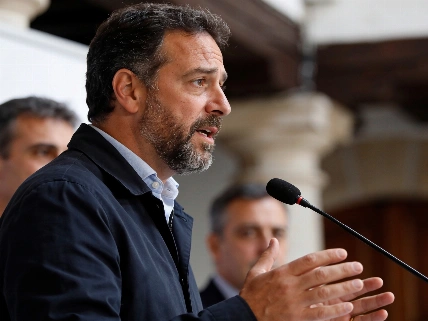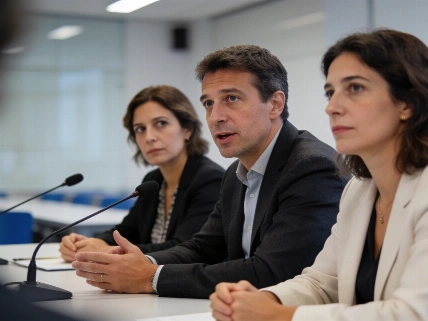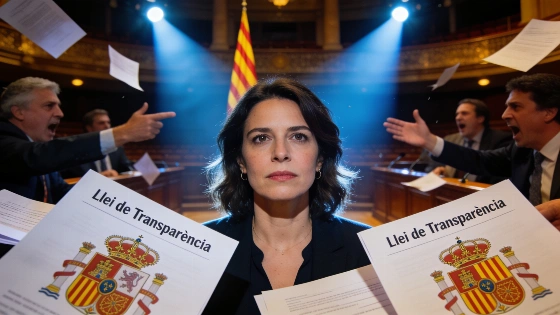
The Spanish government has granted a partial pardon to Laura Borràs, reducing her prison term. However, her 13-year ban from public office stands, fueling political debate and criticism from multiple parties.
The Spanish government’s decision to grant a partial pardon to Laura Borràs, former president of the Catalan Parliament, has reignited political divisions in Catalonia and beyond. While the move spares Borràs from serving a four-year prison sentence, it leaves intact her 13-year disqualification from holding public office—a point that continues to draw sharp criticism from her supporters and fuel accusations of political motivation.
The Council of Ministers approved the partial pardon after the Tribunal Superior de Justicia de Catalunya, which sentenced Borràs in 2023 for irregular contract awards during her tenure at the Institut de les Lletres Catalanes, recommended clemency. The court had described the original prison term as excessive, noting that Borràs did not act for personal gain. The government’s decision, published in the BOE, reduces her sentence to two years, effectively preventing her incarceration but maintaining the lengthy ban from public roles.
Josep Rull, current president of the Catalan Parliament, welcomed the reduction in Borràs’s sentence but emphasized that the continued ineligibility undermines any sense of full justice. He described the original conviction as disproportionate and argued that the ongoing ban perpetuates what he sees as a politically charged pursuit. Borràs herself acknowledged relief at avoiding prison but insisted that the government’s action was prompted by the court’s own recommendation, not by any independent initiative. She maintains that the fight to restore her reputation is far from over, especially as the prosecution had opposed the pardon on the grounds that she had shown no remorse.
The partial pardon has also exposed rifts within the Socialist Party. Emiliano García-Page, president of Castilla-La Mancha and a frequent critic of Pedro Sánchez’s leadership, condemned the move in a radio interview, labeling it a concession to separatist demands and warning that it damages the credibility of Catalan institutions in the fight against corruption.
Meanwhile, the Partido Popular has framed the pardon as a political transaction, suggesting it is a “first payment” to Junts in exchange for support on the 2027 national budget. Lorena Roldán, the party’s spokesperson in the Catalan Parliament, accused Borràs of manipulating contracts and criticized the government for what she called a shameful decision. In response, Míriam Nogueras, leader of Junts in Congress, pointed out that the same court that convicted Borràs had requested the pardon, and highlighted the recent agreement between PP and PSOE over the leadership of the General Council of the Judiciary.
Nogueras also dismissed any suggestion that Junts would back Sánchez’s budget, referencing the government’s low execution rate of planned investments in Catalonia—just 8.6% in 2025, according to recent disclosures. She argued that neither the current nor previous administrations have delivered on financial commitments to the region.
The Borràs case is the latest in a series of high-profile legal and political disputes in Catalonia, reflecting ongoing tensions between regional and national authorities. Similar controversies have surfaced in other institutional appointments, such as the recent reappointment of David Bondia as Síndic de Barcelona, which also highlighted deep political divides within local government. For more on the political dynamics surrounding key Catalan institutions, see this analysis of the recent Síndic de Barcelona reappointment.
Partial pardons in Spain are rare and typically reserved for cases where courts themselves recommend leniency. The Borràs decision underscores the complex interplay between judicial recommendations, executive action, and political strategy. While the immediate effect is to keep Borràs out of prison, the unresolved issue of her ineligibility ensures that the debate over justice and political interference in Catalonia will persist. The case also illustrates the broader challenges facing Spain’s political system as it navigates regional demands, coalition politics, and public expectations of accountability.