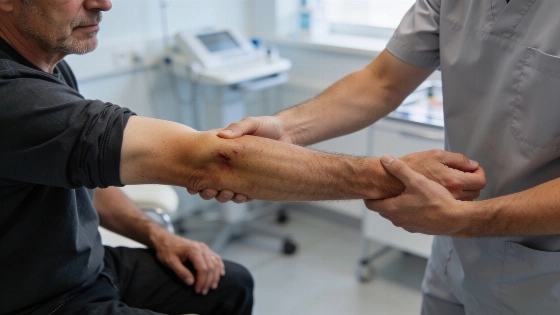
A Spanish-led treatment cleared a stubborn battlefield infection. The patient avoided amputation and regained some elbow movement after receiving a bacteriophage alongside colistin.
A Spanish-led treatment cleared a drug-resistant infection that threatened to cost a war-injured patient his limb. Doctors had considered amputation to stop the bacteria from reaching his bloodstream. Instead, they used a personalized bacteriophage with colistin. The infection cleared, and the wound began to heal.
The patient is a 52-year-old man who suffered severe injuries during a conflict in 2022. He underwent several operations. The wound then developed a persistent infection caused by Klebsiella pneumoniae, a bacterium resistant to several medicines. Standard antibiotics failed to eliminate it, leaving the medical team with few options.
The University Hospital of Frankfurt reported 10 successfully treated patients after launching its personalized phage-therapy program in February 2026, an indication that the approach is beginning to move beyond isolated case reports.
The turning point came when doctors contacted Pilar Domingo and her team at the Environmental and Biomedical Virology Group of the Institute for Integrative Systems Biology. The institute is a joint centre of the Spanish National Research Council and the University of Valencia. Researchers selected and characterised a bacteriophage that could attack the strain found in the patient. They then produced it for treatment.
Doctors gave the virus intravenously and directly at the affected site. Colistin was administered alongside it under compassionate-use authorisation from the Spanish Agency for Medicines and Medical Devices. The response was quick. The bacterium was no longer detected in wound samples by the eighth day.
Later tests also remained negative.
A 2026 coordinated European clinical recommendation describes personalized phage therapy as an option when standard treatments are ineffective, unavailable or unacceptable. It also stresses that a phage must be matched to the patient’s specific bacterial strain before treatment, while acknowledging that controlled clinical evidence remains limited.
During follow-up, the wound gradually closed. The patient recovered some movement in his elbow. The improvement continued without reported adverse effects linked to the treatment. The work was carried out with the General Defence Hospital in Zaragoza and published in the International Journal of Infectious Diseases, according to the CSIC.
The case differs from the road incident described in an earlier report. In this case, the danger did not end when the initial trauma was treated. It remained inside a deep, surgically damaged wound. Resistant bacteria could still threaten tissue, implants or bone and force further operations.
That is why bacteriophages are drawing attention as a possible partner to antibiotics and surgery. These viruses attack specific bacteria instead of acting against many microbes at once. Researchers can therefore match the treatment to the strain found in an individual patient. The same precision also limits how widely one preparation can be used. Laboratory selection and production must come first.
German medical publications, including Apotheken Umschau and Ärzte Zeitung, describe phage therapy as an option when antibiotics fail. They say preparations may be given intravenously, through the nose, as a sterile hydrogel for wounds or by inhalation.
Armed conflicts can raise the risk of persistent infections. Medical access may be restricted, supplies may be scarce and treatment may be delayed. Deep wounds are especially difficult when they involve bones, prostheses or implants. Klebsiella pneumoniae remains a difficult pathogen. Current research continues to focus on carbapenem resistance and hypervirulent strains.
In this case, the personalized approach produced three results. The bacterium disappeared from testing. The wound began to heal. Amputation was avoided.
The report does not show that phage therapy can replace antibiotics or surgery. The 2026 European recommendation also says that controlled clinical evidence remains insufficient. It calls for treatment to be organized by a multidisciplinary team that includes clinicians, microbiologists and phage specialists.
Clinical development is still under way. More studies are needed to measure the treatment's effectiveness and set protocols for routine care. The case does show its possible value in a narrower situation. When a multiresistant infection leaves standard treatment unable to save a limb, a bacteriophage matched in the laboratory to the patient's strain can offer another route. That is a reason to develop personalized anti-infection treatments before surgery becomes the only remaining option.