La Pausa has reopened after a careful restoration led by Peter Marino. The villa keeps Coco Chanel's austere design and personal details, while Matthieu Blazy uses it for Chanel's first spring campaign.
In 1928, Coco Chanel designed La Pausa with Belgian architect Robert Streitz, who was 27 at the time. The villa now sits at the center of Matthieu Blazy's first spring campaign for Chanel. Models move through its rooms and staircases. Alec Soth's photographs connect Chanel's original world with the present.
Peter Marino restored the property without turning it into a museum piece. He studied hundreds of archive photographs before rebuilding the house's visual language. The work covered the interiors, furniture, layout and gardens. The goal was to recover the feeling of the 1930s, not create a polished replica.
Coco Chanel sold La Pausa in 1953. The Chanel fashion house bought the villa back in 2015, returning the property to the brand after decades outside its control.
La Pausa was never just a fashionable address. Chanel imagined a Mediterranean ideal with restrained rooms and wide views over the pale blue bay. According to an independent account by Zadovoljna Nova, the design also drew on her childhood memories of Aubazine Abbey.
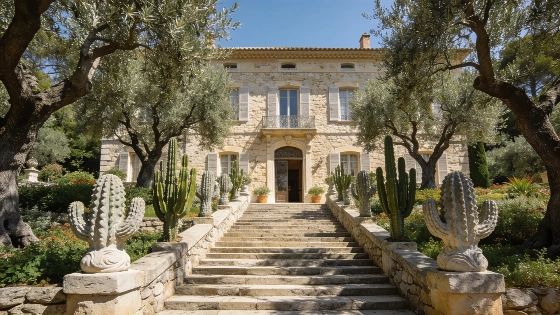
The land shaped the house. Two hundred and fifty olive trees surround the property. The sea, green groves, southern light and untamed landscape define its setting. Pale colours, clean lines and abundant light give the villa a quiet style inspired by Palladian principles.
One detail carries Chanel's biography inside.
La Pausa reopened in June 2025 as a private residence and a setting for cultural and creative programmes, not as a hotel or a ticketed museum. Its renewed role allows the villa to remain in use while preserving the atmosphere of Chanel’s former home.
The broad stone staircase echoes the staircase at the Aubazine abbey, where Chanel spent part of her childhood. A suggested cloister surrounds the inner courtyard. Stone arches, dark solid-wood furniture, and Spanish and Persian rugs soften the brilliant white walls.
Marino added modern plumbing, ventilation and electrical systems. He kept them almost invisible. In the bedroom, he restored two large Baroque mirrors beside the wrought-iron bed. Venetian-style curtains and a bright star complete the bed. The mirrored bathroom and dressing table, filled with creams, lotions and perfumes, were also recreated with close attention to the original atmosphere.
La Pausa's garden is part of the house's story. Dry-stone walls frame cypresses, lavender, jasmine and twisted olive trees. Cushions, hammocks and swings create places to pause across the estate. During Chanel's time, the property hosted tennis, dancing, dinners and celebrations with artists and friends such as Salvador Dalí, Luchino Visconti and Sidonie-Gabrielle Colette. AD Magazine describes the villa as both a private retreat and a meeting place for an important artistic and cultural circle.
The campaign gives the setting a present-day role. Blazy's collection enters rooms shaped by the founder, while Soth photographs the models moving through the villa in an informal atmosphere. La Pausa connects the current Chanel house with a place that has long formed part of its visual and cultural vocabulary.
Yana Peel of CHANEL Arts, Culture & Heritage said the restoration was meant to return Gabrielle Chanel's creative spirit to La Pausa. The estate is also expected to remain a place where artists can live and work. They can spend time there away from everyday distractions. The name La Pausa appears in Chanel's product language as well, including the "La Pausa" shade in Rouge Coco.
The result goes beyond a cosmetic renovation. La Pausa keeps the austerity, symmetry and natural setting Chanel chose. Hidden infrastructure lets the house function today. New campaigns and future artistic activity give the villa a working cultural role. Its history is not behind glass. It is being used. That suits a house built around independence, restraint and creative exchange.