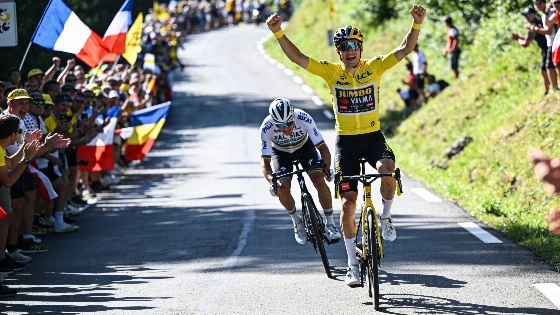
Tadej Pogacar secured his fourth stage win in the Tour de France with a commanding ride in the Vosges. Paul Seixas moved up to fourth overall and took the white jersey. The next stage features a challenging new climb.
Tadej Pogacar delivered a powerful performance in the 14th stage of the Tour de France, conquering the demanding terrain of the Vosges and securing his fourth stage victory of the race. The Slovenian rider once again demonstrated his dominance, leaving rivals behind on a day marked by relentless attacks from the very start. His display not only reinforced his position at the top of the general classification but also set the tone for the decisive mountain stages ahead.
French cyclist Paul Seixas became the focus of national attention after a determined ride that saw him overtake Juan Ayuso for the white jersey by a margin of just three seconds. Seixas, who now sits fourth overall, managed to hold off Jonas Vingegaard in the final kilometers, underlining his growing status in the peloton. The shift in the young rider classification added further intrigue to a Tour already rich in drama and unexpected developments.
The stage was animated from the opening kilometer, with multiple attacks shaping the race early on. While Pogacar proved untouchable on the steepest sections, Seixas’s resilience against established contenders drew widespread praise. The French public responded enthusiastically to his breakthrough, as the battle for podium positions intensified heading into the final week.
Attention now turns to Sunday’s stage, which introduces the formidable Plateau de Solaison to the Tour de France for the first time. This new climb, stretching 11.3 kilometers with an average gradient of 9% and ramps reaching 9.7%, is expected to be a decisive test for the general classification contenders. Before the final ascent, riders will also face two third-category climbs and the first-category La Croisette, setting the stage for further shake-ups in the standings.
In a related development, the Tour de Auvernia-Ródano-Alpes—formerly known as the Dauphiné—saw Isaac del Toro take victory ahead of Juan Ayuso, highlighting the depth of talent among young riders this season. The evolving dynamics of the Tour de France have drawn comparisons to earlier mountain stages, such as those detailed in recent coverage of dramatic mountain battles and Spanish moves in the race.
The introduction of the Plateau de Solaison is particularly significant, as the Tour continues to seek out new and challenging routes to test the world’s best cyclists. The climb’s steep gradients and length are expected to play a crucial role in determining the final outcome of the general classification. With the white jersey changing hands and the yellow jersey firmly on Pogacar’s shoulders, the coming stages promise further tension and unpredictability. The Tour de France remains a focal point for cycling fans in France and across Europe, with each stage bringing new stories and shifting fortunes.
The Tour de France is one of the most prestigious and demanding events in professional cycling, attracting global attention each July. The race’s mix of flat, hilly, and mountainous stages tests riders’ endurance, strategy, and resilience. The white jersey, awarded to the best young rider, often signals the emergence of future stars. As the peloton prepares for the decisive Alpine stages, all eyes will be on the leaders and those hoping to make a late charge up the standings.