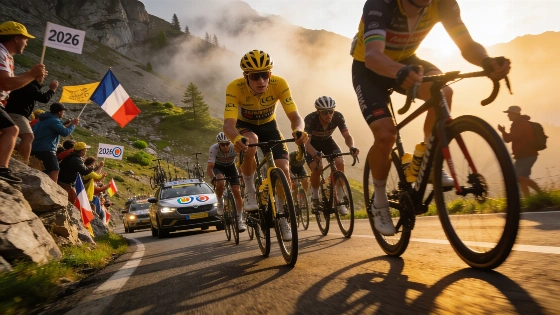
Tadej Pogacar and Jonas Vingegaard underwent surprise doping controls before Stage 15. The mountain route from Champagnole to Plateau de Solaison is set to test all contenders. Spanish riders and mechanical issues add tension.
Stage 15 of the Tour de Francia 2026 opened with unexpected tension as Tadej Pogacar and Jonas Vingegaard were subjected to early-morning doping controls, according to Le Parisien. Pogacar was tested at 5:00 a.m., while Vingegaard faced his check at 2:00 a.m., disrupting their rest ahead of a critical mountain stage. The route from Champagnole to Plateau de Solaison is considered one of the most demanding of this year’s race, with steep climbs and a decisive summit finish expected to shape the general classification.
The day began with a neutralized start at 13:20 local time, but action quickly escalated. Early in the stage, Richard Carapaz launched an attack at 250 km to the finish, targeting mountain points. Spanish rider Azparrez seized the lead at 146 km, while mechanical problems plagued several contenders: Seixas suffered a puncture after 36 km, marking the second such incident for Decathlon, and both Isaac del Toro and Tiesj Benoot lost time due to bike issues at 162 km. Warren Barguil attempted a breakaway at 163 km, but his move was neutralized by the peloton.
Sprint points were fiercely contested in Saint-Laurent-en-Grandvaux, with Jasper Philipsen closing the gap to Mads Pedersen in the green jersey competition. The Alpecin team controlled the pace after a calm start, and the first categorized climb arrived just 151 km from the finish, setting the tone for a day of relentless elevation changes. The final ascent at kilometer 177.2 is widely seen as the stage’s defining challenge, with the Plateau de Solaison expected to determine the day’s winner and potentially the overall leader.
Pogacar entered Stage 15 as the clear favorite, having already secured four stage victories in the first 14 days and holding a record of six career Tour de Francia stage wins. His dominance was evident in the previous stage, and he remains the rider to beat as the peloton tackles the Alps. The Slovenian’s performance is closely watched, especially after the disruption caused by the overnight doping controls. As noted by José Félix Parra in AS, the opening section of the final climb is particularly punishing, demanding maximum effort from all contenders.
Spanish interest remains high, with local riders making aggressive moves despite setbacks. The day’s events follow a pattern of unpredictable developments in this year’s Tour, including mechanical failures and tactical shifts. For a look at how Spanish cyclists have influenced recent mountain stages and the impact of sudden setbacks, see the detailed coverage of the Alsace stage in recent mountain drama and Spanish moves.
The Tour de Francia is renowned for its rigorous anti-doping protocols, and surprise controls are not uncommon, especially before decisive stages. The Plateau de Solaison, a climb familiar to many in the peloton, is notorious for its steep gradients at the base, often splitting the group early. With the general classification still open and several teams pushing for stage glory, Stage 15 is set to play a pivotal role in the outcome of the 2026 edition. The combination of early-morning disruptions, mechanical issues, and fierce competition on the climbs underscores the unpredictable nature of this year’s race.
For context, the Tour de Francia is one of cycling’s Grand Tours, attracting global attention and featuring a mix of flat, hilly, and mountainous stages. The Plateau de Solaison has previously served as a decisive battleground in past editions, often favoring climbers with explosive power. The green jersey competition remains tight, with sprinters like Philipsen and Pedersen battling for every point. As the race enters its final week, every stage carries increased significance for both overall contenders and those targeting individual honors.