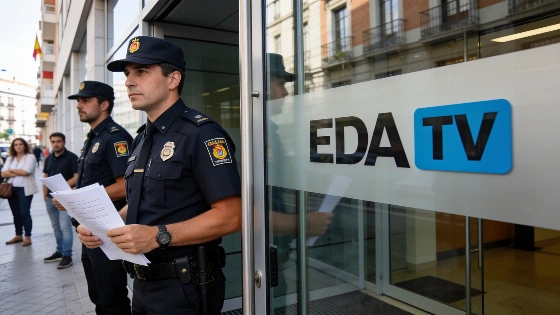
Madrid police arrived at EDA TV to detain Vito Quiles, but he was absent. The controversial reporter faces five ongoing legal cases. The specific reason for the arrest warrant remains undisclosed.
Police officers arrived at the headquarters of EDA TV, a YouTube-based channel located on Madrid’s Calle de Lagasca, on Wednesday morning with a court-issued arrest warrant for Vito Zoppellari Quiles, widely known as Vito Quiles. The attempt to detain the high-profile agitator was unsuccessful, as Quiles was not present at the office. According to sources familiar with his work, Quiles spends most of his time reporting from the streets rather than at the channel’s newsroom.
The authorities have not disclosed which of the five ongoing judicial cases against Quiles prompted the arrest order. On social media, Quiles confirmed the existence of the warrant but did not specify the related case. He attributed the legal action to what he described as a campaign of mass complaints from associates of Prime Minister Pedro Sánchez, following an incident involving Begoña Gómez. Quiles accused the government of using the justice system to target political opponents, while also claiming that officials portray themselves as victims when facing corruption allegations.
Juan Gonzalo Ospina, Quiles’s lawyer, confirmed the police visit to EDA TV and criticized the measure as disproportionate. Ospina argued that authorities could have notified either Quiles or his legal representative directly, or visited his home instead of the company’s premises. The lawyer also stated he was unaware which of the five open cases led to the arrest order.
Among the legal proceedings, Renfe has filed a complaint against Quiles for alleged fraud. The railway company accuses him of repeatedly traveling full routes with tickets valid only for partial journeys, unauthorized use of VIP lounges, and causing reputational harm to the company. This case is being handled by a court in Alicante. In another case, Quiles faces charges of hate crime against a person with a disability who protested against Madrid’s regional president, Isabel Díaz Ayuso, in 2024. Prosecutors are seeking a two-year prison sentence and a five-year ban from practicing journalism.
Quiles is also under investigation for allegedly revealing secrets and harassing Beatriz Corredor, president of Red Eléctrica (REE), after he posted her home address and photos of her property online following the April 28, 2025 blackout. This case is being processed by Madrid’s Court of Instruction No. 23, where Quiles appeared in April to testify. Additionally, a court in Seville is investigating him for alleged insults and slander against Rubén Sánchez, secretary general of the consumer group Facua. The private prosecution is seeking nine years in prison for repeated slander with ideological aggravation, as well as €60,000 in damages and a ban on journalistic activity for 20 months. Sánchez has clarified that the current arrest warrant is not related to his case.
Some previous cases involving Quiles have been dismissed. In May 2026, a judge in Majadahonda closed a complaint filed by Begoña Gómez, the prime minister’s wife, regarding alleged harassment in a restaurant, citing lack of evidence. Earlier that month, another case was dropped after reviewing security footage of an incident involving political analyst Sarah Santaolalla outside the Senate, which showed no aggression by Quiles. The PSOE had reported Quiles for harassment of several senators and Santaolalla, but the court found no grounds for prosecution.
In a separate development, the Spanish Congress withdrew Quiles’s press accreditation for three months in May after he filmed and broadcast images of former Prime Minister José Luis Rodríguez Zapatero in a restricted area of the chamber. This followed a series of incidents involving Quiles and another agitator, Bertrand Ndongo, leading to their temporary suspension under public administration procedures. The ongoing legal and political tensions surrounding figures like Quiles reflect broader disputes over media conduct and political accountability in Spain. These disputes have also been highlighted in other recent cases, such as the controversy over leaked confidential data involving José Luis Rodríguez Zapatero, as reported in coverage of privacy and information leaks in Spain.
Spain’s legal system allows for arrest warrants to be issued when a defendant fails to appear in court or when authorities believe there is a risk of flight or obstruction of justice. High-profile cases involving media personalities often attract public attention, especially when they intersect with political controversies. The situation with Vito Quiles underscores ongoing debates about the boundaries of journalistic activity, the use of legal measures in political disputes, and the responsibilities of both media and public officials. As the legal processes continue, the outcome of these cases may influence future standards for press conduct and the handling of politically sensitive incidents in Spain.