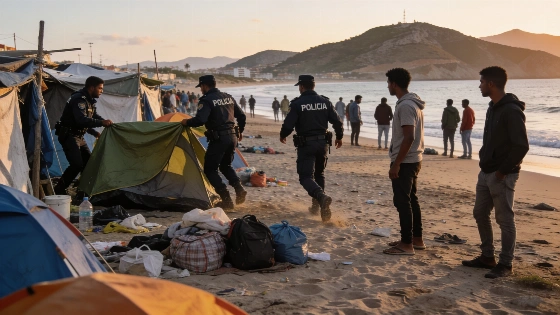
Authorities in Ceuta have once again cleared Trampolín Beach, but hundreds of migrants quickly returned. The cycle of evictions and reoccupation highlights the persistent migration crisis in the city.
Ceuta’s Trampolín Beach remains at the center of a persistent migration standoff, as police carried out another early morning operation to remove migrants from the area. Despite a coordinated effort by security forces and Ministry of Inclusion staff, who relocated 1,800 people to prepared facilities just a day earlier, around 500 migrants returned to the beach overnight. The authorities arrived at 7:30 a.m., dismantling makeshift tents and dispersing those present, but the occupation resumed almost immediately after police withdrew.
Most of the migrants are young men from North Africa who arrived during the mass crossings at the end of July. While the authorities had previously described the eviction as “voluntary,” many migrants said they remained on the beach because they were told it was an option. This time, however, the focus was on clearing the area rather than offering new accommodation. The beach, once covered by over a hundred improvised shelters, saw a smaller number of tents reappear as soon as the police left, underscoring the limited impact of repeated clearances.
Conditions remain harsh for those staying in the area. Migrants continue to sleep on the sand or in the surrounding hills, where basic sanitation is lacking and the risk of illness is high. Local residents, especially those living in nearby villas, have expressed growing frustration and fatigue as the situation drags into its fourth week. The city council has indicated that further clean-up operations will continue, but the cycle of eviction and return shows no sign of ending.
The humanitarian challenge in Ceuta extends beyond Trampolín Beach. Every corner of the city now hosts makeshift camps, as migrants wait for a chance to apply for asylum—though most are aware that their prospects are slim unless they can prove specific grounds for protection. The ongoing crisis has drawn national attention, with previous government actions including the urgent transfer of vulnerable minors to mainland Spain, as detailed in reports such as the recent relocation of 500 migrant girls from Ceuta.
Ceuta’s unique position as a Spanish enclave on the North African coast makes it a frequent entry point for irregular migration. The city’s limited resources and infrastructure are under strain, and the repeated occupation of public spaces like Trampolín Beach highlights the broader challenges facing Spanish authorities. As the situation evolves, the focus remains on balancing humanitarian needs with public order, but a lasting solution remains elusive.