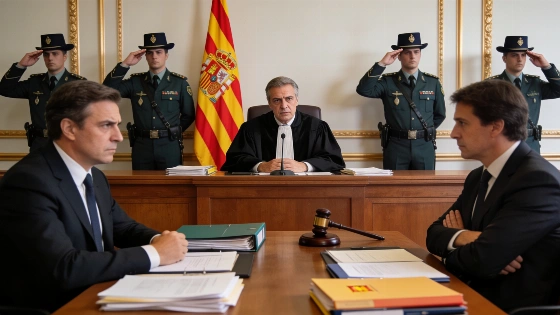
The Partido Popular has asked the National Court to suspend the command powers of Mercedes González and General Llamas over the UCO. The party cites risks of retaliation against investigators in a high-profile case involving alleged interference in probes linked to the PSOE.
The Partido Popular (PP) has formally requested that Judge Santiago Pedraz of the National Court suspend the authority of Mercedes González, director general of the Guardia Civil, and her deputy, Lieutenant General Manuel Llamas, over the Central Operative Unit (UCO). This move comes as both officials remain under investigation for allegedly using internal disciplinary measures to influence ongoing probes into the PSOE and the government, a case that has drawn significant political attention.
According to the PP's submission, the continued presence of González and Llamas at the top of the Guardia Civil hierarchy poses a risk to the integrity of the investigations. The party argues that their direct command over UCO agents—who are actively involved in sensitive inquiries—could lead to reprisals or pressure on witnesses and officers. The PP specifically points to the case known as Leire Díez, which centers on an alleged scheme to obstruct investigations related to the PSOE and government officials.
The PP's petition, made public on Friday, urges Judge Pedraz to impose precautionary measures that would strip González and Llamas of any command functions over the UCO, especially regarding the Department of Economic Crime and Anti-Corruption, led by Lieutenant Colonel Antonio Balas. The party also seeks to prevent the two officials from initiating or handling internal investigations against UCO agents, as well as from accessing documents or systems tied to the ongoing judicial case.
Despite the legal proceedings, both González and Llamas have retained their posts, a situation the PP criticizes as a sign of government inaction. The party also calls for the former Guardia Civil chief, Leonardo Marcos, to be summoned as a suspect, citing witness claims that he instructed the UCO to take a passive stance in the investigation involving David Sánchez, the brother of Prime Minister Pedro Sánchez, who was recently barred from office for nine years due to a conviction for malfeasance.
PP vice-secretary Alma Ezcurra emphasized in a press briefing that ongoing investigations must proceed without interference from those under judicial scrutiny. Internal UCO reports referenced in the case suggest that the alleged network led by former PSOE member Leire Díez sought to use disciplinary proceedings as a tool to intimidate investigators, leveraging Díez's prior relationship with González to facilitate this strategy.
Mercedes González, who is considered a close ally of Prime Minister Pedro Sánchez and enjoys the support of both the prime minister and Interior Minister Fernando Grande-Marlaska, has defended herself before Judge Pedraz, claiming to be a political victim of the alleged plot orchestrated by Santos Cerdán and Leire Díez. The law governing Spain's security forces already restricts access by police leadership to judicial investigations, requiring agents to report only to the presiding judge.
In addition to targeting the current and former leadership of the Guardia Civil, the PP has asked the court to expand the investigation to include Vicente Fernández, former president of SEPI; the former president of Correos and ex-chief of staff to Sánchez; and two other Correos officials. The party alleges these individuals were involved in creating a tailor-made position at the public postal service for Díez, drawing parallels to a previous case in Badajoz involving the prime minister's brother.
The ongoing legal and political dispute highlights the complex intersection of law enforcement, politics, and judicial oversight in Spain. The UCO, as a specialized unit within the Guardia Civil, plays a key role in high-profile corruption and economic crime cases. The outcome of this case could have significant implications for the independence of police investigations and the accountability of senior officials. In recent years, Spain has seen increased scrutiny of the relationship between political leadership and law enforcement, with several high-profile cases prompting calls for greater transparency and safeguards against interference. The current proceedings underscore the challenges faced by judicial authorities in balancing institutional stability with the need for impartial investigations, especially when top officials are themselves under suspicion.