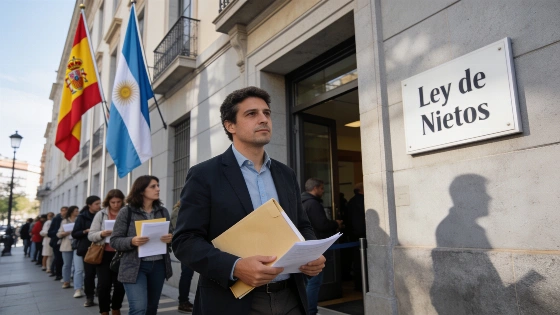
The 'ley de nietos' has undergone 32 parliamentary steps in five years. The PP now questions the process, citing haste and lack of transparency. Over 2.4 million have sought nationality under the law.
The process behind Spain's 'ley de nietos', a provision within the Ley de Memoria Democrática granting nationality to descendants of exiled Spaniards, has become a flashpoint in national politics. Despite passing through 32 parliamentary steps over five years—including multiple debates, hundreds of amendments, and official publications—the Partido Popular (PP) has intensified its criticism, focusing on alleged procedural haste and opacity rather than the law's substance.
Since its introduction, the law has seen extensive legislative scrutiny: nine debates in both chambers, 16 publications in the Boletín Oficial de las Cortes Generales, five in the Diario de Sesiones, and two in the Boletín Oficial del Estado. The government points to these figures to counter claims of rushed approval, highlighting that the law was debated for years and received 469 amendments, 93 from the PP itself. The controversial instruction clarifying the law's application was published in the BOE in October 2022, nearly four years ago.
Historically, prominent PP figures such as Manuel Fraga, Alberto Núñez Feijóo, Alfonso Rueda, and Ester Muñoz publicly supported measures to restore nationality to the grandchildren of exiles, framing it as a matter of justice. Their pledges, made in both Spain and Buenos Aires, did not question the origins or voting intentions of potential beneficiaries. Despite the PP's long-standing governance in Galicia and the limited electoral impact of the external vote, the party has recently shifted its stance, now demanding a review of all granted files, contracts, and involved officials.
The legislative journey began with the law's presentation to the Constitutional Commission in August 2021, followed by a lengthy amendment period and a seven-month commission report. The final text, including the now-debated additional provision on nationality, was shaped by input from all parties. Notably, amendment 430, signed by then-PP spokesperson Cuca Gamarra, proposed language that closely mirrors the current provision, allowing descendants of exiles to opt for Spanish nationality under specific conditions.
To address ambiguities left by both the original Ley de Memoria Histórica and its updated version, the Ministry of Justice issued an instruction in October 2022. This document clarified that eligibility extends not only to children and grandchildren of exiles but also to descendants affected by exile due to sexual orientation or identity, and to children born abroad to Spanish women who lost their nationality by marrying foreigners before 1978. While these clarifications drew little controversy at the time, only the far-right Asociación para la Reconciliación y la Verdad Histórica challenged the instruction in court, but their appeal was dismissed by the Tribunal Superior de Justicia de Madrid.
Recently, the ultra-conservative group Hazte Oír filed a criminal complaint against the director general of Justice, alleging administrative misconduct. Government sources interpret the renewed controversy as part of a broader strategy by the PP and Vox to cast doubt on executive actions, even those aligned with longstanding PP positions in Latin America. The instruction in question serves as guidance for consular staff, not as a binding order, and the pace of applications has been steady rather than rushed.
According to the Ministry of Política Territorial y Memoria Democrática, as of March 31, 2.4 million people had requested appointments at consulates to apply for nationality under the law. Of these, 1.2 million formal applications were submitted, and 544,722 have been approved, with 306,000 already registered. The Ministry of Justice notes that, in comparison, over 296,000 nationality applications by residence were processed in 2025 alone, with more than 221,000 approvals, underscoring that the 'ley de nietos' process is far from expedited.
This debate over the nationality law echoes broader tensions within Spanish politics, where procedural disputes often mask deeper disagreements. For context, internal party conflicts and legal challenges have also surfaced in other areas, such as the recent situation involving the PP's leadership in Valencia, as detailed in this report on party dynamics in Valencia. The ongoing scrutiny of the 'ley de nietos' highlights the intersection of historical memory, legal process, and political rivalry in Spain's evolving legislative landscape.
Spain's approach to historical memory laws reflects a broader European trend of addressing past injustices through legal reforms. The 'ley de nietos' specifically targets the descendants of those who fled during the Franco era, aiming to restore rights lost due to political exile. The law's implementation has required significant administrative resources, particularly in consular offices abroad, and has prompted debate over the balance between reparative justice and procedural rigor. As the number of approved applications grows, the practical impact on Spanish society and its diaspora continues to unfold, with ongoing political debate likely to shape future reforms.