A major immigration conference was cancelled after PP-led regions refused to attend. The government accuses the opposition of blocking dialogue on migrant regularization. Over a million applications are at stake.
The Spanish government's attempt to advance its extraordinary migrant regularization process hit a wall this Thursday, as regional governments led by the Partido Popular (PP) collectively refused to attend a crucial sectoral conference. The absence of these regions forced the Ministry of Inclusion, Social Security and Migration to cancel the meeting due to lack of quorum, stalling discussions on the future of more than 1.1 million pending applications.
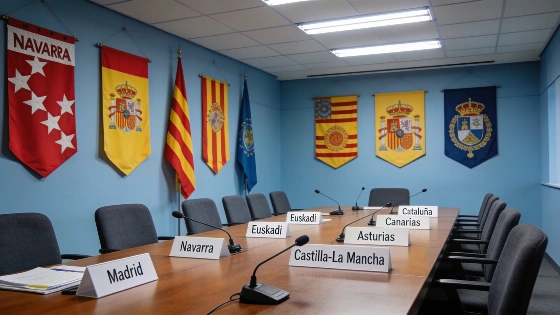
Minister Elma Saiz, who convened the conference, sharply criticized the PP for what she described as a deliberate blockade. She argued that the party had abandoned its role as a state institution, accusing it of acting as an "antisystem" force. Saiz highlighted that only six autonomous communities—Navarra, Euskadi, Cataluña, Canarias, Asturias, and Castilla-La Mancha—sent representatives, whom she praised for their institutional loyalty and sense of responsibility.
The conference was set to review the progress of Spain's largest-ever extraordinary regularization of migrants, with 1,174,968 applications registered. According to Saiz, the process has already enabled nearly 70% of cases to move forward, and she pointed out that in Madrid alone, over 50,000 people are now contributing to social security as a direct result of the initiative. She also noted that, for the first time, the invitation extended to regional ministers responsible for migration in communities governed jointly by PP and Vox, raising questions about whether the boycott was coordinated at the national party headquarters or influenced by Vox's stance.
In response, Ana Dávila, Madrid's regional minister for Family, Youth and Social Affairs, spoke on behalf of the PP-led regions. She accused the central government of operating with opacity and undermining the conference's purpose of inter-administrative cooperation. Dávila criticized the timing of the meeting—fifteen months after the previous session—and claimed that all requests for information from the Ministry had been ignored. She cited the lack of access to meeting minutes and recordings, as well as the absence of economic impact studies on the regularization process, as evidence of unprecedented institutional disloyalty.
Saiz countered that the Ministry had increased coordination efforts, holding more preparatory meetings and information exchanges than ever before. She alleged that, even in the run-up to the conference, the PP attempted to impose an agenda that would have halted the regularization process, which she described as essential for granting rights and dignity to thousands of people living on the margins.
With the sectoral conference cancelled, the Ministry shifted to bilateral talks with the regions that did attend, focusing on the European Pact on Migration and Asylum, the government's Integration and Citizenship Plan, and the ongoing status of the regularization files. The standoff underscores the deepening divide between Spain's central government and several autonomous communities over migration policy, echoing other recent disputes between regional and national authorities. For example, tensions between the PP and other political forces have surfaced in various contexts, such as when a PP event in Bilbao was disrupted by protesters, highlighting the broader climate of political confrontation.
Spain's extraordinary regularization process is one of the largest in Europe, reflecting the country's ongoing efforts to address the realities of migration and integration. The current impasse may delay not only the processing of applications but also the implementation of broader integration measures. The debate over transparency, institutional cooperation, and the role of regional governments remains central as Spain navigates complex demographic and social changes. The outcome of this standoff could influence future national and regional approaches to migration, with practical consequences for both newcomers and long-term residents.