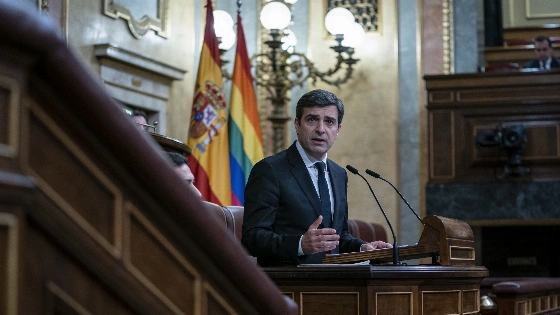
Jaime de los Santos, PP's deputy secretary for Education and Equality, has announced plans to revise Spain's Trans Law. The party aims to require psychosocial reports for gender changes, challenging current self-determination rules.
The Partido Popular (PP) has signaled a major shift in its approach to Spain's Trans Law, with Jaime de los Santos, the party's deputy secretary for Education and Equality, confirming that the PP will seek to introduce stricter requirements for legal gender changes. De los Santos stated that, if the PP comes to power, individuals wishing to change their gender in the Civil Registry would need to present psychosocial reports confirming gender dysphoria, replacing the current system based on self-determination.
This announcement comes after de los Santos made headlines in the Congress by openly declaring his sexual orientation and party affiliation during a debate on legislation penalizing so-called conversion therapies. While the PP abstained from voting on the bill, the party has indicated it will push for tougher penalties and clearer definitions when the law reaches the Senate, citing concerns over legal uncertainty in the current draft.
De los Santos, who oversees the PP's policies on women's rights and the LGTBIQ+ community, has criticized the concept of gender self-determination as unrealistic. He argues that requiring medical and psychosocial documentation is necessary to prevent potential abuses and to ensure that the transition process is handled with appropriate safeguards, particularly for minors. According to de los Santos, transitioning is a complex and often traumatic experience that demands robust protections.
Addressing criticism from both political opponents and LGTBI organizations, de los Santos defended the PP's participation in Madrid's Pride events and rejected accusations of backtracking on LGTBI rights. He also condemned homophobic rhetoric from Vox, emphasizing that the PP would not support any rollback of existing rights, including those related to abortion laws.
On the issue of conversion therapies, de los Santos explained that the PP's abstention was due to concerns about the legal clarity of the proposed legislation. He called for a precise definition of what constitutes a conversion therapy to ensure legal certainty and to allow for harsher penalties where appropriate.
When questioned about internal cases of harassment within the PP, de los Santos stressed the importance of presumption of innocence and allowing the judiciary to handle such matters independently.
Spain's Trans Law, which currently allows individuals to change their legal gender based on self-identification, has been a subject of intense debate since its introduction. The PP's proposed reforms would mark a significant departure from the current framework, potentially affecting the process for thousands of residents. The discussion reflects broader tensions in Spanish politics over the balance between individual rights and regulatory oversight in matters of gender identity. As the debate continues, the outcome could have lasting implications for legal and social policy in Spain.
For context, Spain was among the first European countries to pass comprehensive LGTBI rights legislation, and its Trans Law has been seen as one of the most progressive in the region. However, the question of how to regulate gender changes remains contentious, with political parties divided over the appropriate level of medical involvement and legal safeguards. The PP's stance may influence future legislative developments and shape the national conversation on gender identity and rights.