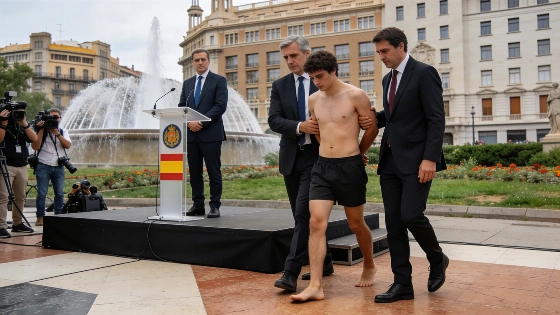
A Partido Popular (PP) press conference in Barcelona was abruptly interrupted when a young man living in precarious conditions in the Vila Olímpica area confronted party leaders over their stance on immigration. The incident unfolded as Elías Bendodo, the PP’s deputy secretary for regional and municipal policy, and Daniel Sirera, the party’s local leader and mayoral candidate, addressed the media near the Cobi fountain, a site recently occupied by homeless people.
The disruption came as PP representatives called on Prime Minister Pedro Sánchez and Barcelona mayor Jume Collboni to take stronger action on migration and dismantle informal settlements. Shirtless and visibly agitated, the young man stepped onto the stage and challenged the party’s rhetoric in Catalan, saying he was living on the streets despite his parents’ professional backgrounds and a lack of support. Sirera escorted him away from the cameras. Bendodo remained silent during the interruption.
Afterward, Bendodo said the PP would attend the sectoral commission on Childhood and Adolescence scheduled for August 13, where officials were due to discuss the situation of unaccompanied foreign minors in Ceuta and their transfer to other regions. He said the party was willing to listen, but did not set out the position of PP-governed regions on receiving the minors. The dispute reflects a wider disagreement over how responsibility for accommodation should be shared between the central government and Spain’s autonomous communities. The State Attorney General has instructed prosecutors to intervene if a region refuses to accept unaccompanied minors.
The meeting took place in the aftermath of large-scale crossings toward Ceuta on July 30 and 31. Later estimates put the number of people attempting to reach the Spanish enclave at roughly 70,000 to 90,000, including children and families. Bendodo cited 150 deaths as evidence of the crisis; other figures in subsequent accounts ranged from 100 to at least 141. The differing tallies have kept the human cost at the center of the dispute over the government’s response.
Bendodo criticized the government’s handling of migration, saying the situation in Ceuta had worsened while Sánchez was on holiday. He accused the prime minister of mishandling diplomatic relations, particularly with Italy and Morocco. Sánchez later said Spain and Morocco had to act “to prevent further loss of life,” adding, “We need Morocco to stop this mass influx.” He has also described cooperation with Morocco as impressive to managing migration toward Ceuta and Melilla. The exchange showed how border control has become bound up with diplomatic coordination and the capacity to receive migrants.
The row over the transfer of minors has also exposed tensions between Madrid and regional administrations. Before the July crossings, Ceuta president Juan Jesús Vivas supported distributing minors among Spain’s regions; from August 1, he opposed the arrangement until vulnerable children could be accommodated through basic-government resources. The Canary Islands later turned to prosecutors and the courts over alleged delays in transfers, taking the dispute beyond political negotiation and into legal oversight.
The Cobi fountain, chosen as the backdrop for the press conference, has become a symbol of Barcelona’s struggles with homelessness and informal settlements. Sirera described the area as a metaphor for the city’s decline from its Olympic legacy to its current challenges. The confrontation brought those urban concerns into a wider debate about migration and social exclusion. Local authorities face pressure to address public order while responding to humanitarian needs.
The PP’s criticism also echoed broader calls from Ceuta’s leadership for stronger national support. Vivas said, “In Ceuta, our dignity as a nation is at stake,” and accused Sánchez’s government of abandoning the city. Disputes over border management and care for unaccompanied minors, including which regions must take responsibility, continue to shape the political debate. A recent escalation of political rhetoric in Ceuta has drawn national attention to the broader debate on migration and border control.