Princess Leonor and Infanta Sofía joined young Girona Foundation participants at Empúries, the only Iberian site with both Greek and Roman city remains. The visit followed the Princess of Girona Awards ceremony in Barcelona.
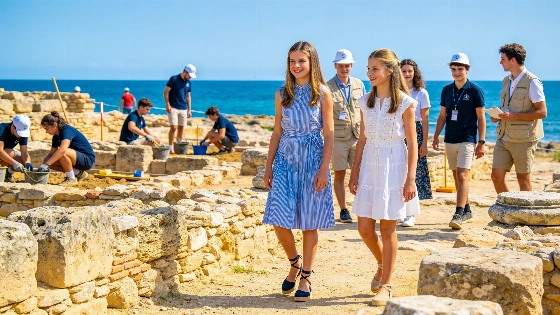
Princess Leonor and Infanta Sofía visited the archaeological site of Empúries in Girona on Wednesday, joining young participants from the Fundación Princesa de Girona’s programs and three of the 2026 award recipients. The group included filmmaker Gemma Blasco (Arts), social entrepreneur Hatim Azahri (Social), and biotechnologist Patricia Aymà (Business Creation). Their tour came just a day after the Princess of Girona Awards ceremony at Barcelona’s Gran Teatre del Liceu, highlighting the royal family's ongoing engagement with youth initiatives and cultural heritage.
Empúries stands out as the only location on the Iberian Peninsula where the remains of both a Greek and a Roman city coexist, with origins dating back to the 6th century BC. During the visit, Princess Leonor greeted young archaeologists working on current excavations, underscoring the site's role as a living research hub. The group was guided by Mònica Borrell, director of the Museu d’Arqueologia de Catalunya (MAC) Empúries, and technical director Marta Santos, who provided insights into the ongoing work and the significance of the site.
Nearly 20 young people from Girona, Barcelona, and Lleida, all involved in the foundation’s programs, joined the tour. The princesses also interacted with students from the International Archaeology Course of Empúries, which marks its 80th edition this year. The visit included a stop at the museum, where participants learned about major archaeological discoveries and current scientific projects, including research on ancient port areas.
Following the guided tour, the group attended a meeting led by King Felipe VI for the presentation of the Generational Development Goals (ODG), developed by the foundation’s Youth Advisory Council. Before the session began, the King commented on the family’s enjoyment of Spain’s recent football victory over France, which took place just hours after the awards gala. A video later showed the royal family celebrating Spain’s advance to the World Cup final. The King also mentioned he had kept his promise not to attend any matches before the final, and when asked about traveling to New York for the final, he replied, “We’re working on it.”
Empúries, located on the Bay of Roses facing the Mediterranean, served as a port and entry point for Greek and Roman cultures into the Iberian Peninsula. The Roman city once covered about 22.5 hectares, while the Greek city spanned roughly four. According to museum archaeologist Elisa Hernández, the Greek city is almost fully excavated, though some areas are being re-examined with updated techniques. Only about 20% of the Roman city has been uncovered so far.
Each year, Empúries attracts around 150,000 visitors and has hosted events beyond archaeology, such as the 2018 wedding of Kimbal Musk, brother of Elon Musk. The site remains active thanks to ongoing excavations and research by students from across Europe. This dynamic approach keeps Empúries relevant both as a historical landmark and as a center for academic study.
While the royal visit drew attention to Empúries’ unique heritage, other regions in Spain have recently faced different challenges. For example, emergency teams in Almería have been conducting extensive searches in Los Gallardos after a devastating wildfire, inspecting hundreds of homes and continuing efforts to locate missing residents. More details on these operations can be found in this report on the Los Gallardos fire response.
Empúries’ dual Greek and Roman legacy, combined with its ongoing excavations and educational programs, makes it a focal point for both historical preservation and youth engagement in Spain. The royal family’s involvement highlights the importance placed on connecting new generations with the country’s rich archaeological and cultural resources.