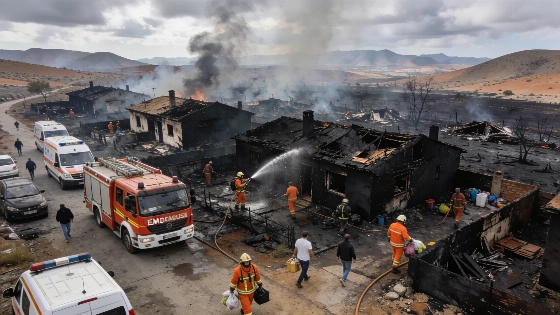
Emergency crews in Almería have combed 217 hectares after a devastating wildfire. Over 100 personnel checked 250 homes, but no new victims were found. The search continues for those still unaccounted for.
Authorities in Almería launched a large-scale search operation on Sunday, targeting the scorched landscape of Los Gallardos after one of Spain’s deadliest wildfires in recent years. With the fire stabilized, ten mixed teams of Protección Civil, Guardia Civil, and UME volunteers methodically covered 217 hectares, focusing on areas where the highest number of victims had been discovered. The operation aimed to locate any remaining missing persons among the devastation left by flames that swept through 7,000 hectares at a pace faster than the wind itself.
The official toll remained at 12 dead and eight injured, four of them in critical condition. Authorities also maintained eight formal missing persons reports and a list of 23 individuals still unaccounted for. Despite the scale of the search, which included the inspection of 250 homes, no additional victims were found. The teams, supported by drones and a helicopter, faced difficult terrain and lingering hot spots, but by late afternoon, officials confirmed that neither survivors nor further fatalities had been located.
Most of the inspected homes were intact, though some had been threatened by the fire. In one case, a collapsed garage raised alarms, but the owner was eventually found alive. The majority of the missing are believed to be foreign nationals, particularly English and Belgian residents of scattered rural properties, which complicated efforts to confirm their whereabouts. At least one relative of a foreign victim provided DNA samples to assist with identification of the deceased.
As aerial units continued to cool the area to prevent flare-ups, the phased return of more than 1,600 evacuees began over the weekend. Residents of Las Pastoras were among the first allowed back, following two days in temporary accommodation. Authorities emphasized that the search for missing persons would continue in the coming days, though with a different approach as the immediate risk diminished.
Investigators from Seprona, the environmental division of the Guardia Civil, are focusing on the suspected cause of the fire: the fall of an old power pole in the Almocáizar area near the A-7. Although the utility company Endesa claims the line was not live, eyewitnesses reported seeing sparks from the cable, which then ignited the blaze and allowed it to jump the road, spreading rapidly uphill in strong winds. Part of the cable has been removed for analysis, while the rest remains visible on the hillside where the fire advanced.
In the coming days, efforts will shift toward consolidating control over the fire’s 40-kilometer perimeter and assessing the full extent of the damage. Prime Minister Pedro Sánchez is scheduled to visit the affected area, as identification of the deceased and treatment of the injured continue in local hospitals. The Los Gallardos wildfire stands as a stark reminder of the risks posed by aging infrastructure and extreme weather in Spain’s rural regions. According to official data, wildfires have become increasingly destructive in southern Spain, with climate conditions and land management practices under renewed scrutiny. The rapid mobilization of emergency services and the scale of the search operation highlight both the challenges and the resilience of local communities facing disaster.