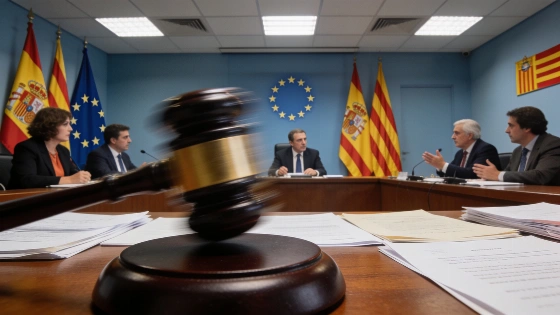
Spain’s public prosecutor has called for the amnesty law to be applied in the Tribunal de Cuentas case on Catalan funds. The move follows a European court decision and could impact high-profile leaders. The Constitutional Court will review related appeals in September.
The Spanish public prosecutor has formally requested that the Tribunal de Cuentas implement the amnesty law in the ongoing case concerning the alleged misuse of public funds during the 2017 Catalan independence referendum and related international activities. This step comes immediately after the European Court of Justice confirmed the legality of Spain’s amnesty legislation, removing a major legal obstacle and intensifying the debate over the fate of several high-profile Catalan leaders.
On Monday, the Tribunal de Cuentas asked all parties involved to submit their positions on whether the amnesty should apply, particularly if European Union funds were implicated in the case. In its response, the prosecutor’s office argued that this request was both unnecessary and inappropriate. According to the prosecutor, both the Tribunal de Cuentas and the EU’s Advocate General had previously ruled out the involvement of EU funds in the alleged offenses. Furthermore, when the preliminary question was raised before the European Court, the possible misuse of EU funds was not part of the discussion.
The prosecutor emphasized that only after the amnesty law was passed did questions arise about whether the funds under investigation might have originated from sources other than the Generalitat de Catalunya. However, both the Supreme Court and the Tribunal de Cuentas had already conducted investigations that did not support this theory. As a result, the prosecutor has called for the suspension on proceedings to be lifted and for the amnesty to be applied without further delay, now that the European legal questions have been resolved.
Meanwhile, the Constitutional Court has scheduled a session for September 22 to deliberate on the first of several appeals filed by Catalan leaders convicted in connection with the procés, whose requests for amnesty were previously denied by the Supreme Court. The first case to be reviewed will be that of Jordi Turull, a former minister in the Catalan government. The Constitutional Court is expected to address the remaining appeals, including that of former president Carles Puigdemont, in subsequent sessions. In total, seven appeals are pending from independence leaders who were denied amnesty on the grounds that their convictions for misuse of public funds were not covered by the law promoted by the Spanish government, ERC, and Junts. The Constitutional Court had postponed its decisions until the European Court’s ruling was issued.
This legal standoff highlights the ongoing complexity of Spain’s efforts to address the aftermath of the 2017 Catalan independence push. The amnesty law, which has been a source of political tension, aims to resolve lingering judicial cases but continues to face resistance in some quarters. The Tribunal de Cuentas’ decision will have significant implications for the future of Catalan political figures and the broader debate over regional autonomy. For additional context on recent political disputes involving Spain’s judiciary and government, see the report on the controversy surrounding the Guardia Civil’s role at Madrid’s May 2 event: recent inquiry into political pressure on law enforcement.
Spain’s amnesty law was introduced as part of a broader political agreement to ease tensions in Catalonia and facilitate dialogue between regional and national authorities. The Tribunal de Cuentas is responsible for overseeing the use of public funds and has played a central role in the legal proceedings against Catalan officials. The European Court’s endorsement of the amnesty has removed a key barrier, but the final outcome will depend on how Spanish courts interpret and apply the law in each individual case. The coming months are likely to be decisive for both the legal status of Catalan leaders and the future of Spain’s territorial politics.