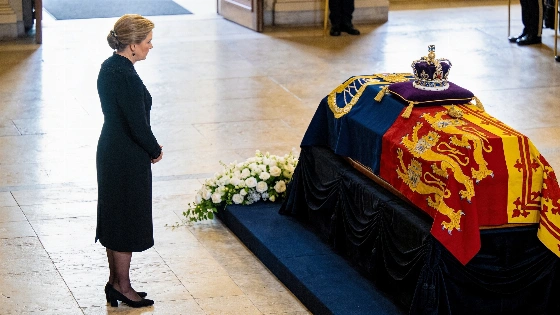
Norway's royal family released a rare photo and a personal message from Queen Sonia as she bid farewell to King Harald V. The tribute highlights the private side of royal grief and the family's legacy.
Queen Sonia was photographed standing alone in front of King Harald V's coffin, a moment that captured the weight of Norway's royal transition. The Royal House of Norway released the image just before the state funeral in Oslo. Dressed in black, hands clasped, her face showed both loss and composure. For many Norwegians, this was an unusually personal glimpse into royal mourning.
The official Instagram post began with the queen's solitary vigil, then showed a close-up of white flowers and a ribbon with her monogram. The message—"gracias por una buena vida"—was brief and personal. Queen Sonia chose the phrase herself, and it now shapes how the public sees her partnership with King Harald V. According to Norwegian and international media, this was the first time an image of Queen Sonia alone before the coffin in the palace chapel (Slottskapellet) was made public. It marked a break from previous royal mourning traditions.
King Harald V was laid to rest in the royal mausoleum at Akershus Fortress in Oslo following the state funeral on September 9, 2026.
One of the images released was a family photograph from decades ago: a young King Harald holding Princess Marta Luisa, and Queen Sonia with the infant Prince Haakon. Sharing this private photo was a deliberate choice by the Royal House, reminding Norwegians of the family's history and the continuity of the monarchy during a time of loss. Several Norwegian outlets noted that the palace has increasingly used social media to connect with the public, sharing both old and new images to foster a sense of closeness during mourning.
The sequence ends with Queen Sonia, seen from behind, facing the royal standard and crown atop the coffin, with only the honor guard nearby. No other family members appear in this frame, highlighting her isolation at a moment of national attention. The post drew thousands of responses online, with citizens expressing support and reflecting on the monarchy's place in Norwegian society. Observers have described the Royal House's approach as more open and personal than the traditions of other European royal families.
As the funeral procession prepared to move through central Oslo, the Royal House's use of social media stood out compared to the more reserved style of other European monarchies. By sharing Queen Sonia's personal grief and family history, the palace shaped how the public experienced this transition. This approach is similar to recent tributes for other public figures, such as the memorial for Rosa Maria Duran, where personal legacy and collective memory were both present.
The Norwegian royal court officially declared a period of mourning until October 9, 2026, during which most official events were canceled or limited. Exceptions included government meetings, the opening of the Storting, and select audiences, reflecting the balance between tradition and state obligations.
Norway's monarchy, like others in Europe, faces the challenge of staying relevant in a changing society. Sharing private moments and images is not only a gesture of openness but also a way to strengthen the monarchy's emotional connection with the public. Queen Sonia's quiet farewell, marked by a single phrase and a family photograph, may leave a stronger impression than any official speech. The palace has chosen to let authenticity and vulnerability define this period, setting an example for how royal families can handle public mourning in the digital age.